Inflationary Sector Renormalization: A Toy Model for Making the Multiverse
One of the big problems with eternal inflation is that it gives you too much universe. Not in the poetic sense. In the accounting sense. If inflation keeps spawning disconnected pocket domains, then every kind of universe can happen an infinite number of times. Once everything happens infinitely often, the simple question “what is likely?” turns into a mathematical junk drawer.
That’s the measure problem: If you count every pocket universe equally, the answer depends on how you cut off the counting. Stop at one cutoff and you get one answer. Stop later and you may get another. The universe starts behaving like one of my carpentry projects.
This paper proposes a toy framework called Inflationary Sector Renormalization, or ISR. The idea is not to solve the full measure problem, that’s a bit too large a claim. This idea is more scaled and useful: instead of counting every simulated inflationary sector equally, weight the sectors that are closer to our observable patch more heavily.
Plain English version: if you’re trying to estimate what kind of vacuum our universe belongs to, don’t let every unrelated sector vote with the same power. ISR weights sectors that are nearby in configuration space, and less weight to ones that are far away.
This is called “renormalization” by analogy, not because it is standard Wilsonian renormalization. In ordinary physics, renormalization often means handling hidden or unresolved degrees of freedom so the final prediction becomes stable. Here, ISR tries something similar in a toy inflationary landscape: average over unobserved sectors in a controlled way, then determine whether the answer stabilizes as more simulated trajectories are added.
The Basic Setup
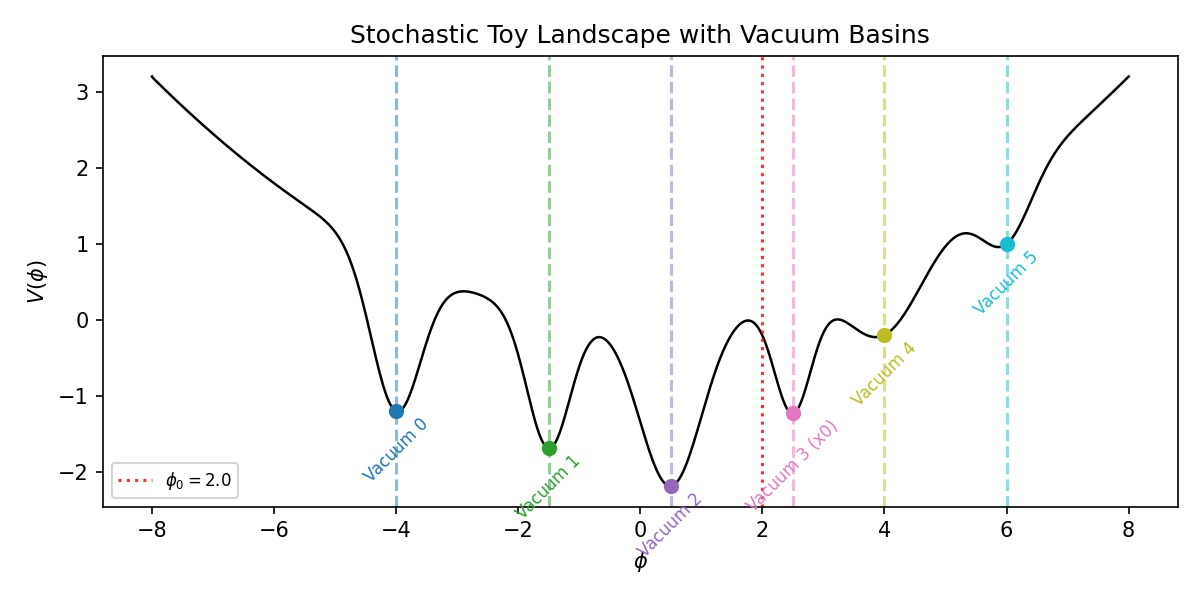
The paper builds a one-dimensional toy landscape, a bumpy valley with several low points. Each low point is a possible vacuum basin. A simulated inflationary trajectory rolls or wanders through this landscape and eventually lands in one of those basins.
The observable patch is placed at φ0 = 2.0. In the toy landscape, that patch belongs to Vacuum 3. The question is then: when we simulate thousands of possible sectors, should the probability estimate be dominated by whichever vacuum gets the most raw counts, or should it be weighted toward the basin near the observable patch?

Global Census vs. ISR
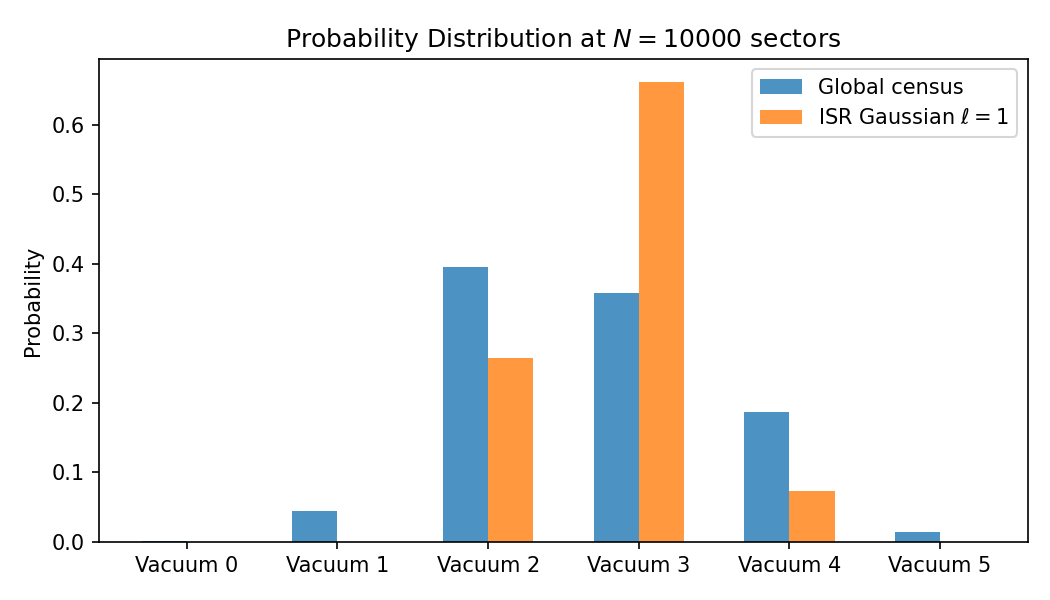
The paper compares two ways of counting the simulated sectors. Global census is the naive method. Every simulated sector gets one vote. If Vacuum 2 gets the most trajectories, Vacuum 2 wins.
ISR is the locality-weighted method; sectors closer to the observable patch get more weight, sectors farther away get less weight. This is done with a kernel, which is a mathematical weighting function. The main version uses a Gaussian kernel with scale ℓ = 1.
The result is the first important difference: at 10,000 simulated sectors, the global census favors Vacuum 2. ISR shifts the probability toward Vacuum 3, which is the basin local to the observable patch.
Why Stability?
The whole point of a measure isn;t just to produce a number, it has to produce a number that doesn’t wobble wildly every time the cutoff is increased. If a probability estimate changes too much when you go from 1,000 to 10,000 trajectories, then the measure is not really telling you something stable, it’s just reacting to the size of the sample.
The paper uses two stability diagnostics:
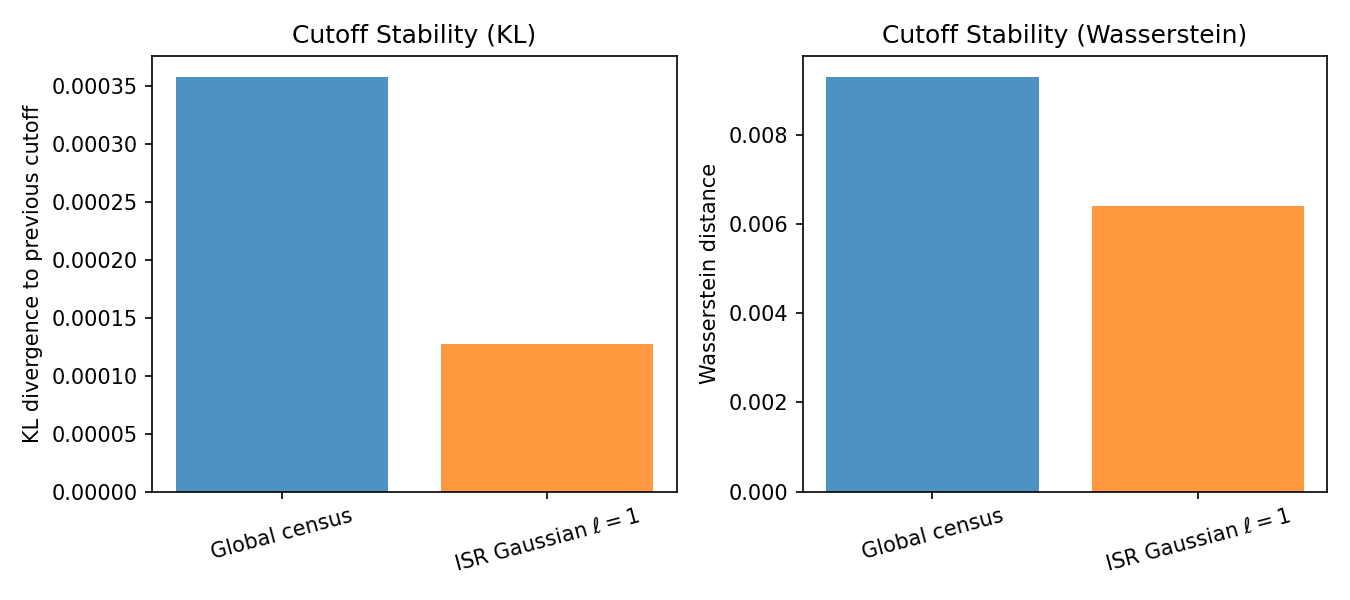
KL divergence measures how much the probability distribution changes from one cutoff to the next, lower is better.
Wasserstein distance is another way to measure how much one distribution has moved compared with another, again, lower is better.
In the main 10,000-sector run, ISR improves both measures compared with the global census. The KL drift falls from about 3.58 × 10⁻⁴ to about 1.27 × 10⁻⁴. That’s roughly a factor-of-two improvement, Wasserstein distance also improves.
The Kernel Problem: How Local Is Too Local?
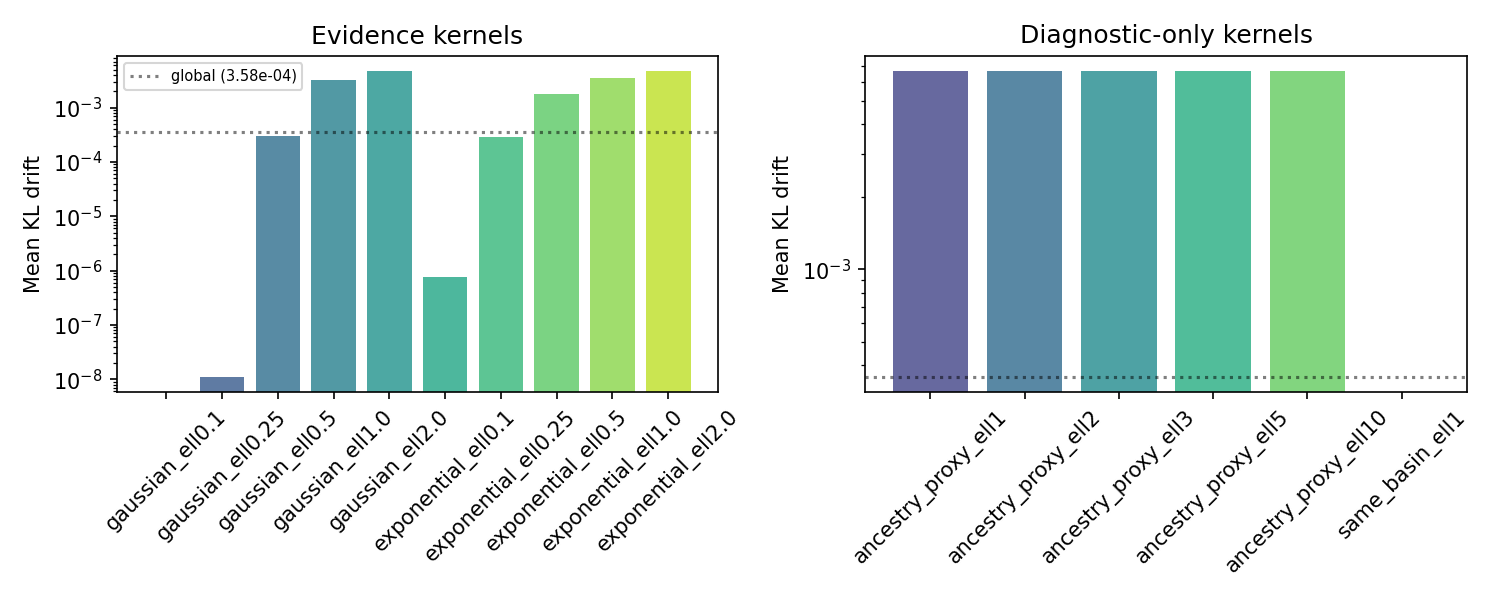
ISR depends on a kernel scale, written as ℓ. This is the knob that controls how wide the neighborhood is.
If ℓ is too small, ISR only sees the local basin and ignores almost everything else. That can make the result look artificially stable, because the model has basically put blinders on. If ℓ is too large, ISR starts behaving like the global census again, because everything gets counted almost equally.
The useful region is in the middle. The paper finds a practical sweet spot around ℓ ≈ 0.5 to 1.5. In that range, ISR has enough sample size to be meaningful, but it still preserves locality.
Where Locality Breaks
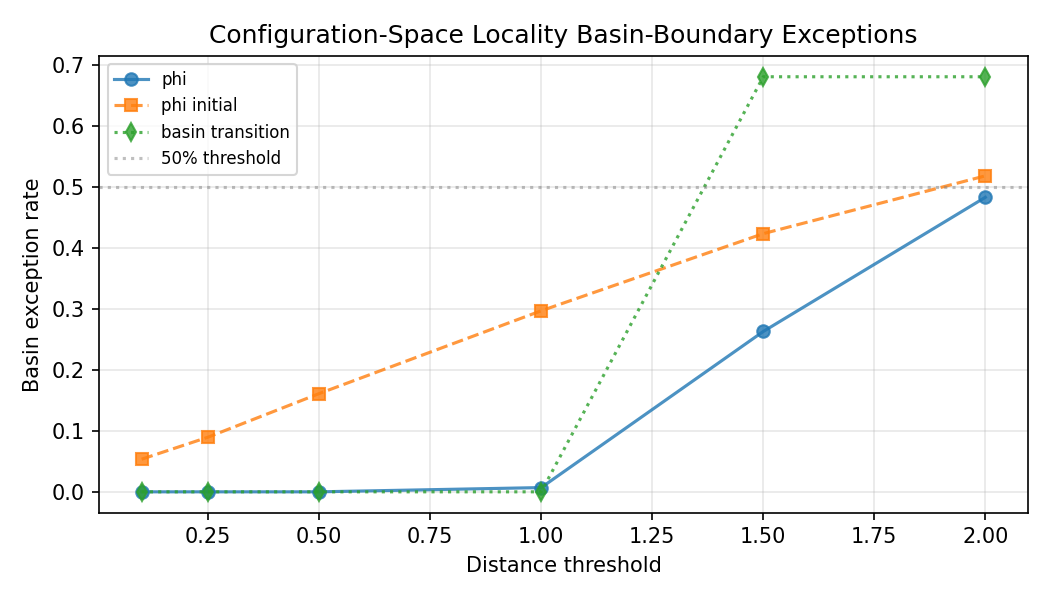
This is one of the most important honesty checks in the paper. Locality is not magic, nearby starting conditions don’t always land in the same vacuum basin. Near a basin boundary, two trajectories can start close together and still end up in different basins.
The paper calls these basin-boundary exceptions. They aren’t swept under the rug, they’re measured.
Sector Averaging: The Coarse-Graining Analogy
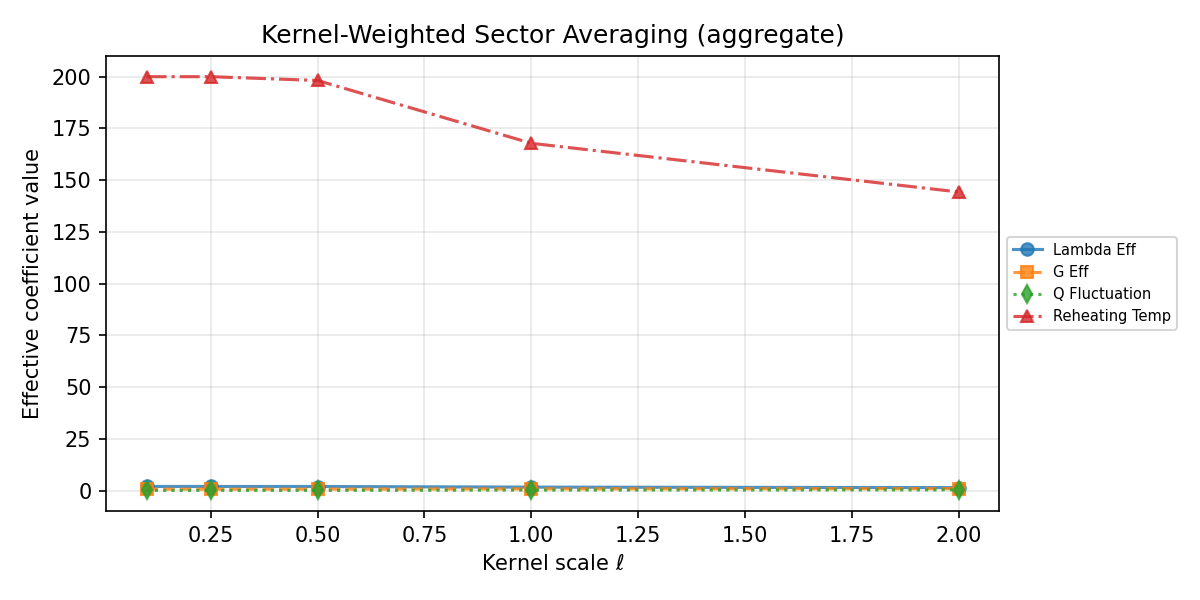
The paper also assigns each vacuum basin a toy set of effective physics values, such as an effective cosmological constant, an effective gravitational coupling, a fluctuation amplitude, and a reheating temperature. These aren’t claimed to be real derived constants, they’re placeholders used to test how ISR changes aggregate values when unobserved sectors are mixed in.
As ℓ increases, more distant sectors are allowed into the weighted average. That changes the effective aggregate coefficients.
The Stress Test
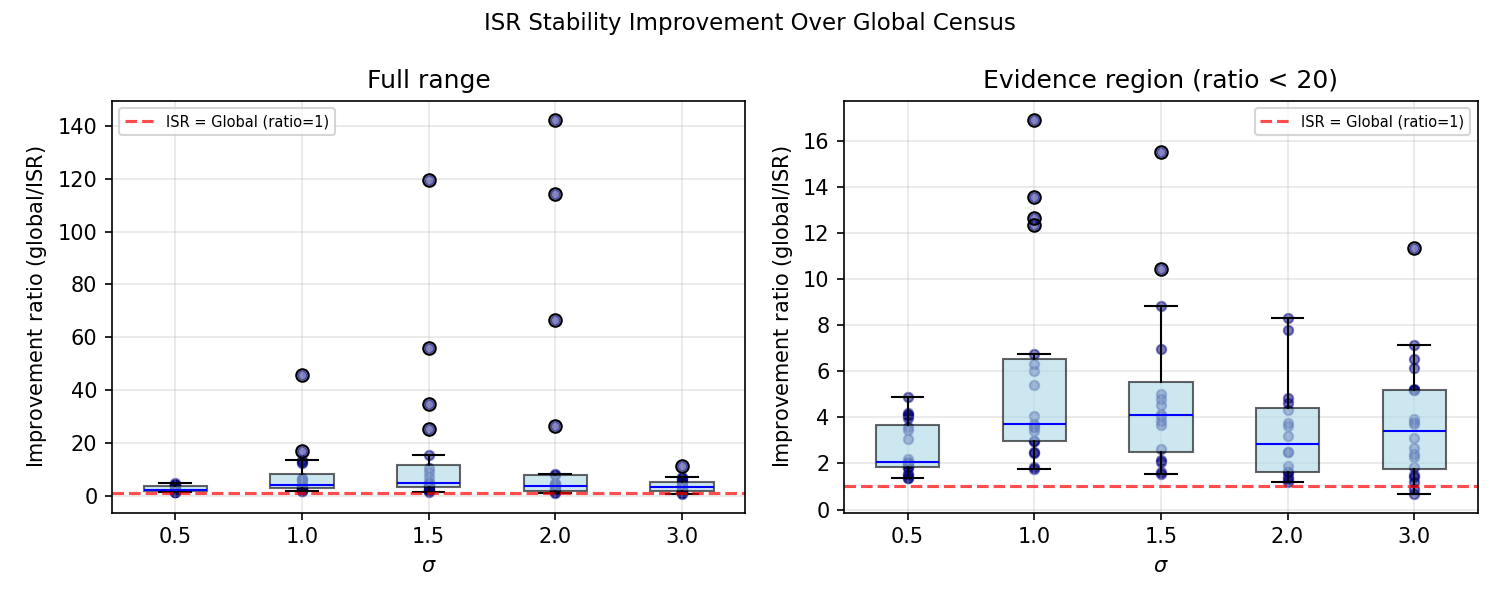
A measure proposal that works only for one seed isn’t very interesting, so the model runs a larger stress test over different random seeds and different starting spreads, written as σ.
Think of σ as how widely the simulated initial conditions are scattered. Small σ means the trajectories start near the observable patch. Large σ means they are sprayed much more widely across the landscape.
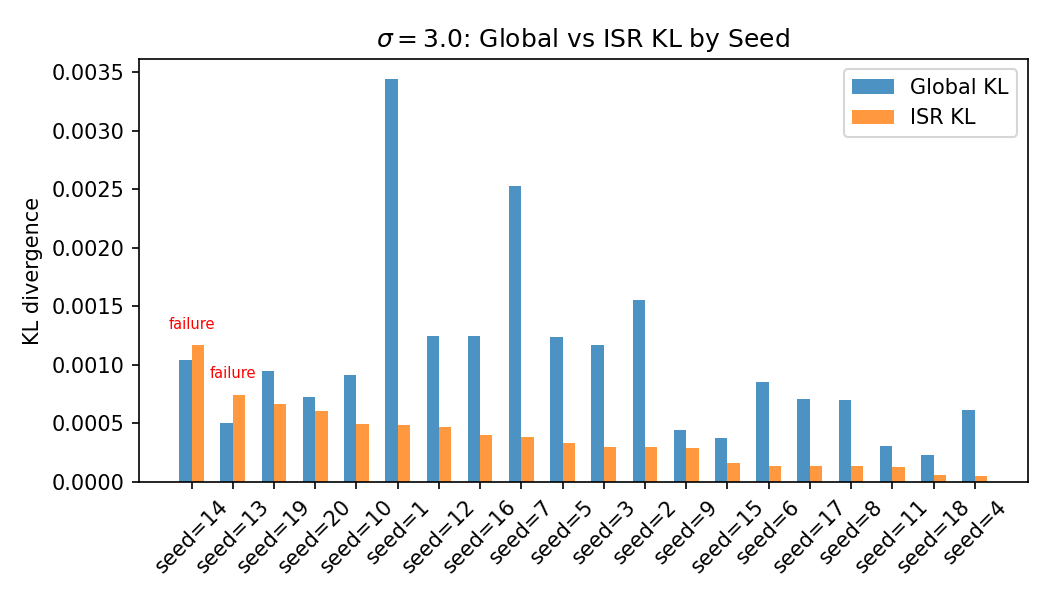
Across 100 sigma-by-seed tests, ISR beats the global census in 98 out of 100 cases. The two failures happen at the broadest spread, σ = 3.0, where the initial conditions are scattered so widely that locality becomes thin and unreliable.
The Failure Cases
The paper doesn’t hide the failures, a toy model that only reports victories is a sales brochure.
At σ = 3.0, the initial spread is so broad that many trajectories sample vacua far from the observable patch. In that regime, the ISR kernel can become too thin or poorly matched to the actual basin structure. The result is that ISR underperforms the global census in two seeds.
The Actual Claims
The claims are:
- A naive global census is cutoff-sensitive.
- A locality-weighted measure can be tested in a finite stochastic landscape.
- In this toy model, ISR shifts weight toward the local basin.
- ISR improves finite-sample cutoff stability compared with global counting.
- The improvement survives most stress tests.
- The method has identifiable failure modes near basin boundaries and broad initial-condition spreads.
ISR is a test bench for a class of measure ideas, to find which one behaves better than naive counting under controlled conditions.
Why?
The measure problem is one of those physics problems where the math can become so infinite that the answer stops meaning anything. ISR tries to bring the problem back into a finite experimental frame. Experimental in the computational sense: build a toy landscape, define the rules, run the sectors, compare the measures, and punish the idea with diagnostics. Even if ISR is not the final answer, the framework gives us a way to ask better questions:
- Does a proposed measure become more stable as the cutoff grows?
- Does it depend too much on a hand-picked kernel?
- Does it fail near basin boundaries?
- Does it still work when the landscape is perturbed?
- Does it outperform the dumb baseline?
Toy Models
This model lets you smash a proposed idea against known failure modes without needing a quantum gravity vending machine in the basement. It defines ways the model could have failed: bad kernel behavior, basin-boundary exceptions, shuffled-distance null controls, broad-sigma failures, and landscape perturbation tests.
Bottom line: Inflationary Sector Renormalization doesn’t solve the eternal-inflation measure problem. But it gives a reproducible toy framework for testing whether locality-weighted counting can beat naive global counting. In this simulation, it does. The next step is to move beyond the one-dimensional toy landscape and see whether the idea survives in nastier terrain.
Inflationary Sector Renormalization in a Stochastic Toy Landscape, Jake Enholm, June 30, 2026.