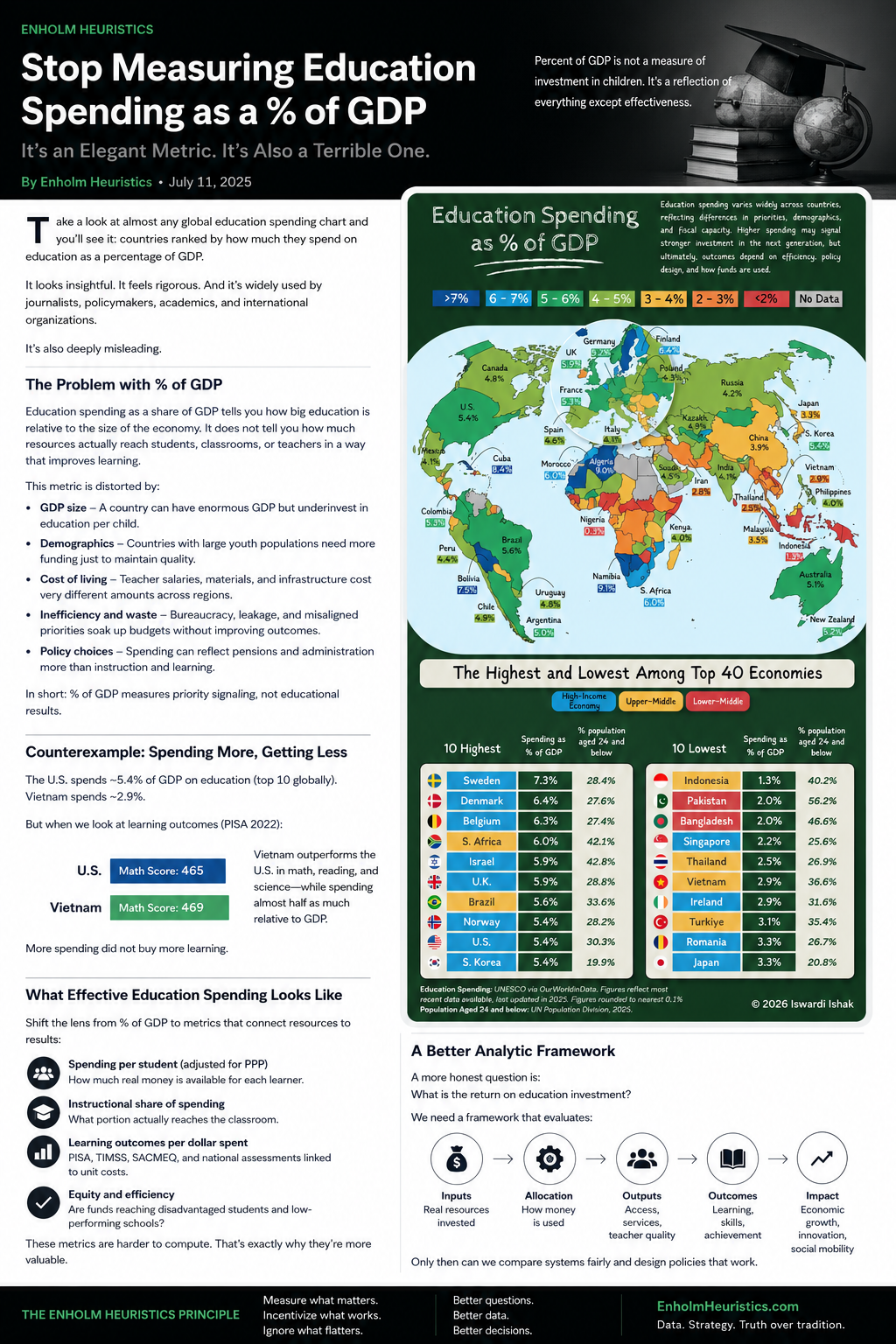
One of the most common statistics in education policy is also one of the least useful. Every year, reports rank countries by education spending as a percentage of GDP. The implication is obvious: higher percentages suggest greater investment in education and, by extension, better educational systems. Reality is considerably more complicated.
A country spending 6% of GDP on education is not necessarily educating its children better than one spending 3%. That number says far more about the size of the economy and government priorities than it does about what actually happens in the classroom.
A more useful framework asks different questions:
- How much is spent per student, adjusted for purchasing power?
- How much of the budget reaches classrooms instead of administration?
- What academic outcomes are produced for every dollar invested?
- How effectively are disadvantaged students served?
- Are graduates leaving school with skills that translate into higher productivity and innovation?
These are much harder metrics to calculate. They’re also much more informative. Consider Vietnam, it spends a far smaller share of GDP on education than many wealthier countries, yet consistently performs at or above OECD averages in several international assessments. Conversely, simply increasing spending has not guaranteed better outcomes in many developed nations. This illustrates a broader analytical principle. Inputs are not outputs.
Economists have long understood that capital investment only matters when it produces productive assets. Education should be evaluated the same way. Dollars are inputs. Learning, skills, productivity, and innovation are outputs. Focusing exclusively on education spending as a percentage of GDP risks rewarding inefficient systems while overlooking highly effective ones that achieve more with fewer resources. The goal of education policy isn’t to maximize spending. The goal is to maximize human capital. As with so many policy debates, better questions produce better analysis. Instead of asking “How much do we spend?”, we should be asking “What are we getting for what we spend?”