Mahan loved a clean finish; army collapses, a capital falls, a fleet is destroyed, or a government signs the surrender papers. The final event gets a name, a date, and a chapter in the history book. That doesn’t happen often though. From an operations research standpoint, we want to know what process moved the losing side into a state where it could no longer recover. A single shock, or the last crack in a system that has been weakening for years.
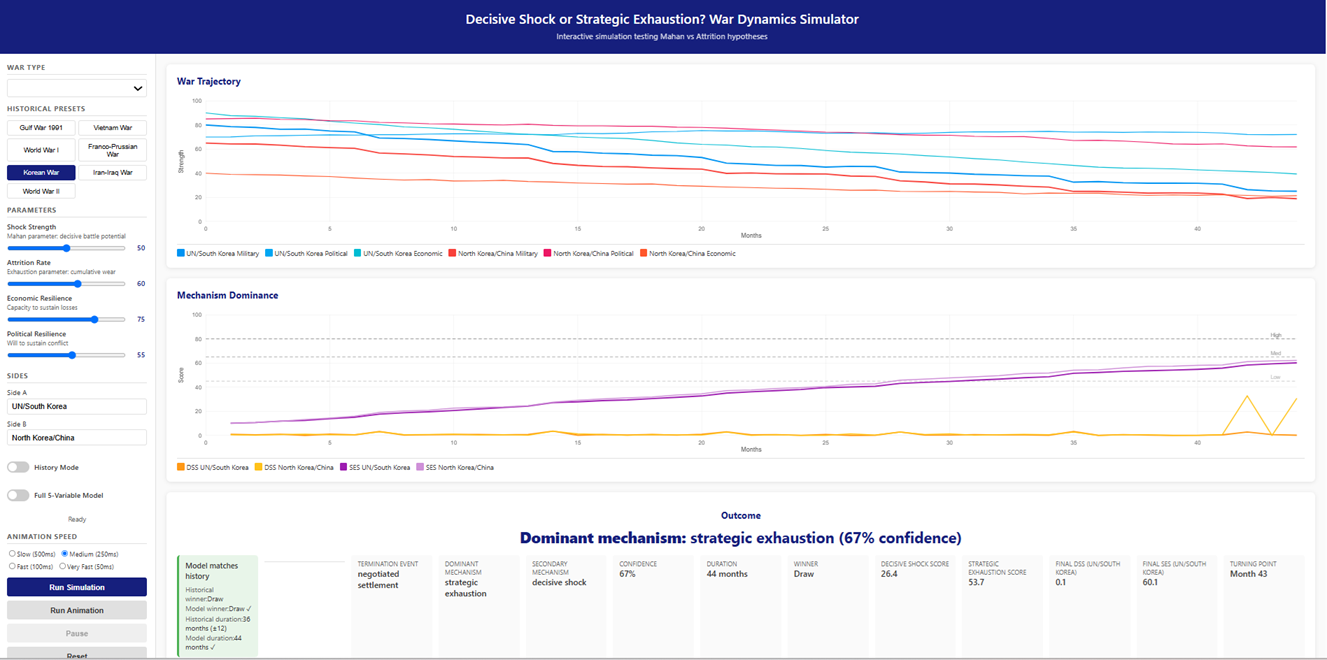
Our paper, Decisive Shock or Strategic Exhaustion? A Dynamical Model of War Termination and the companion browser simulation explores this problem. We built a quantitative framework to separate two different mechanisms:
Decisive shock: the battle, campaign, surprise, or operational collapse that rapidly changes the strategic balance.
Strategic exhaustion: the cumulative loss of military capacity, economic resilience, industrial output, logistics, manpower, and political will.
Both can happen in the same war, the model estimates which mechanism made the losing position unwinnable.
Turning a historical argument into an operations research problem
Mahan’s decisive battle tradition and the attrition tradition are often treated as competing explanations. Mahan says wars are won by concentration, maneuver, and a crushing engagement. Strategic exhaustion says wars are decided by the side that can absorb losses, replace equipment, sustain logistics, and keep the political system functioning. But this binary argument is too tidy for the data.
We framed war termination as a mechanism-classification problem. The model doesn’t try to predict the exact winner, the date of surrender, or the battle that will occur next, instead it estimates whether a conflict is moving through a shock-dominant regime, an exhaustion-dominant regime, or a mixed and uncertain middle. A model that maps the conditions under which shock or exhaustion becomes dominant is doing a job operations research can reasonably attempt.
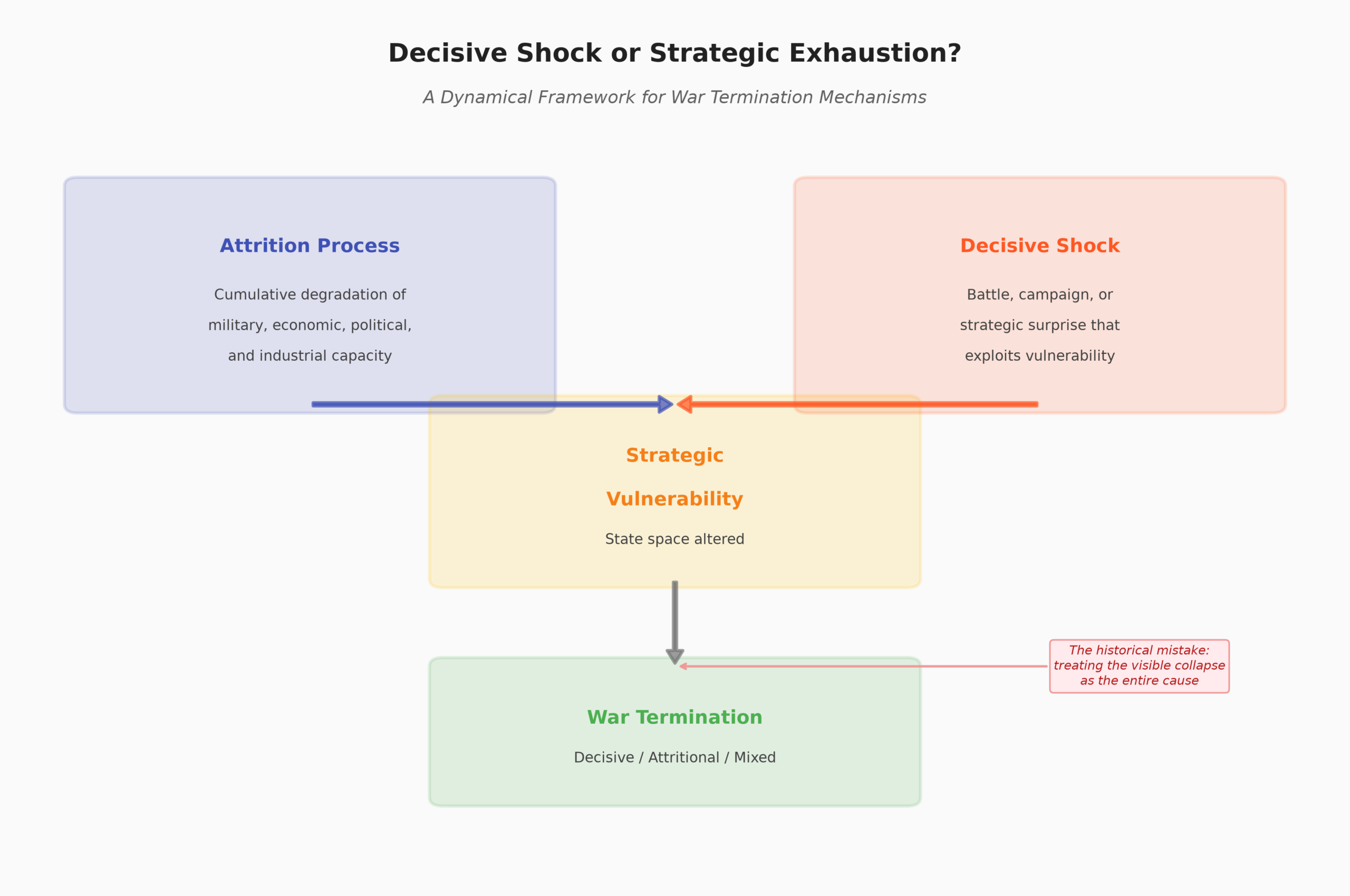
The attritional iceberg. Attrition changes the strategic state, while a decisive shock exploits the resulting vulnerability. The visible collapse may be the ending without being the whole cause.
Two Scores
The empirical side of the project uses two composite measures:
Decisive Shock Score, or DSS, measures the concentration and strategic effect of sudden events. Its components include casualty concentration, temporal clustering, force destruction, proximity to termination, morale cascade, territorial swing, surprise, and alliance collapse.
Strategic Exhaustion Score, or SES, measures cumulative pressure. Its components include mortality burden, duration, economic drain, manpower depletion, territorial attrition, force-ratio movement, logistics strain, morale decay, political-will erosion, and cumulative cost imbalance.
Both scores run from 0 to 100. The classification rule is deliberately conservative, we want to prevent a conflict being shoved into a decisive or attritional box because one score is a few points higher. Strong scores on both axes produce a mixed classification and low or close scores remain uncertain. We want to avoid painting over that uncertain middle, it reflects the blurring reality that many wars contain both mechanisms and the historical data is often incomplete.
What the historical data shows
We integrated records covering 4,812 wars, but complete battle-level information is available for only 91 of them. Among the 91 wars where both scores can be calculated, only 2.2 percent fall into the clear decisive-shock category. Another 22 percent are classified as strategic exhaustion. The remaining 75.8 percent sit in the uncertain, negotiated, or mixed region.
That doesn’t prove three quarters of wars are unknowable, but it shows that clean knockout-punch cases are rare when we apply a conservative rule and refuse to invent missing information. Most historical conflicts occupy a broad middle where shock and exhaustion overlap.
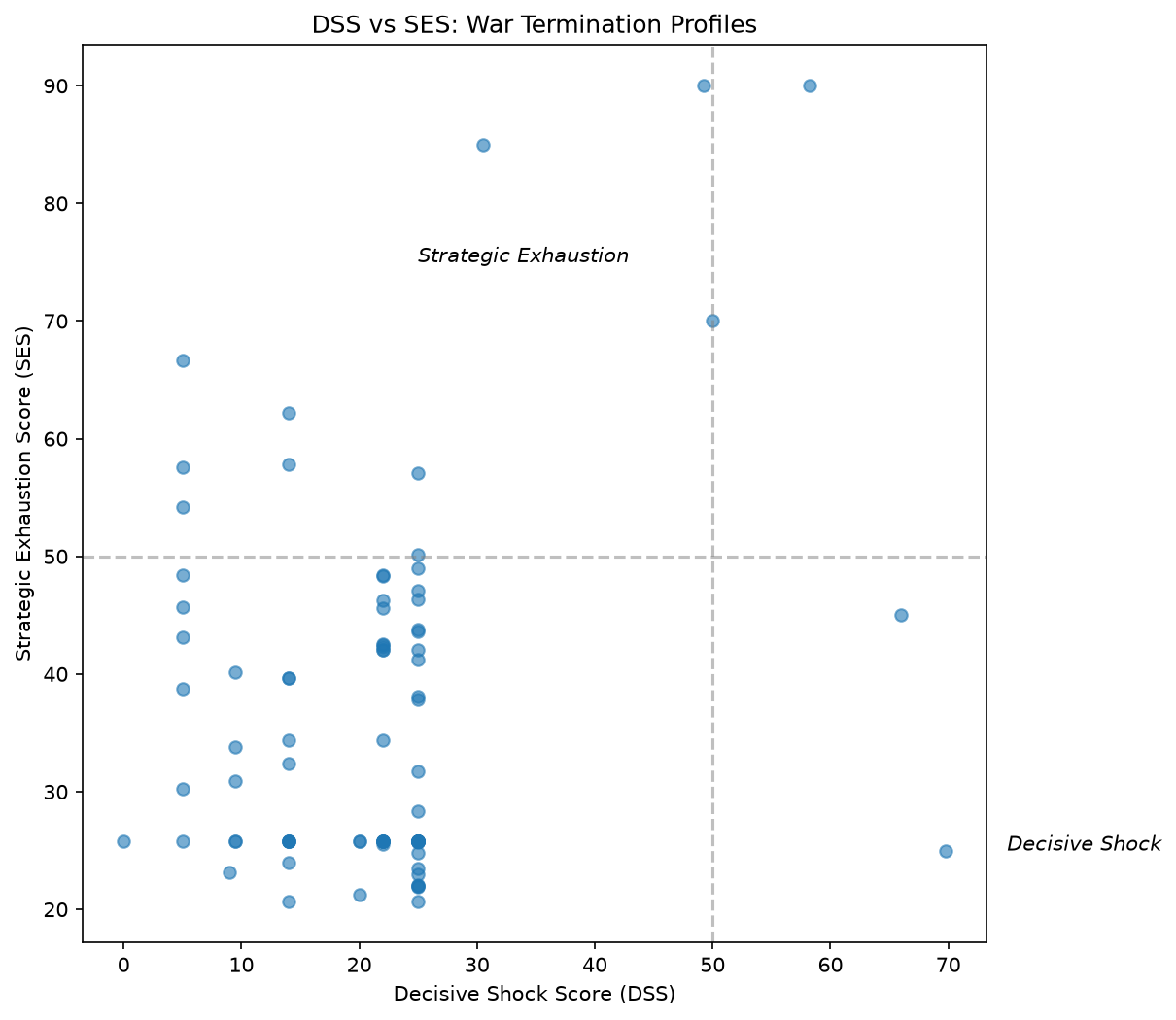
DSS versus SES for the wars with sufficient battle-level data. The empty extremes and crowded left are part of the result.
The problem with hindsight
A serious problem appeared as soon as we audited the DSS components; several of them require information that isn’t available until the war is over. Outcome proximity, morale collapse, territorial change after the main battle, and alliance defections can explain an outcome, but they can’t be predicted with the data available.
So the model separates observed DSS from a structural DSS proxy. Observed DSS answer the question, “Given everything that happened, how much did decisive events contribute to the ending?” The structural proxy answers, “Before the result was known, how much evidence existed for a decisive mechanism?” It uses force ratios, economic disparity, industrial capacity, logistics vulnerability, surprise indicators, alliance asymmetry, mobilization speed, and regime stability.
The gap between those scores is the outcome-information delta measuring how much the war itself revealed. The 1967 Six-Day War has the largest positive gap in the case set. Its observed decisiveness was much greater than the structural conditions predicted. Vietnam moves in the other direction. Pre-war structural conditions can make a conflict look more favorable to decisive action than the actual course of the war supports. The 1991 Gulf War sits closer to what a pre-war analyst could have seen in the force, economic, and industrial imbalance.
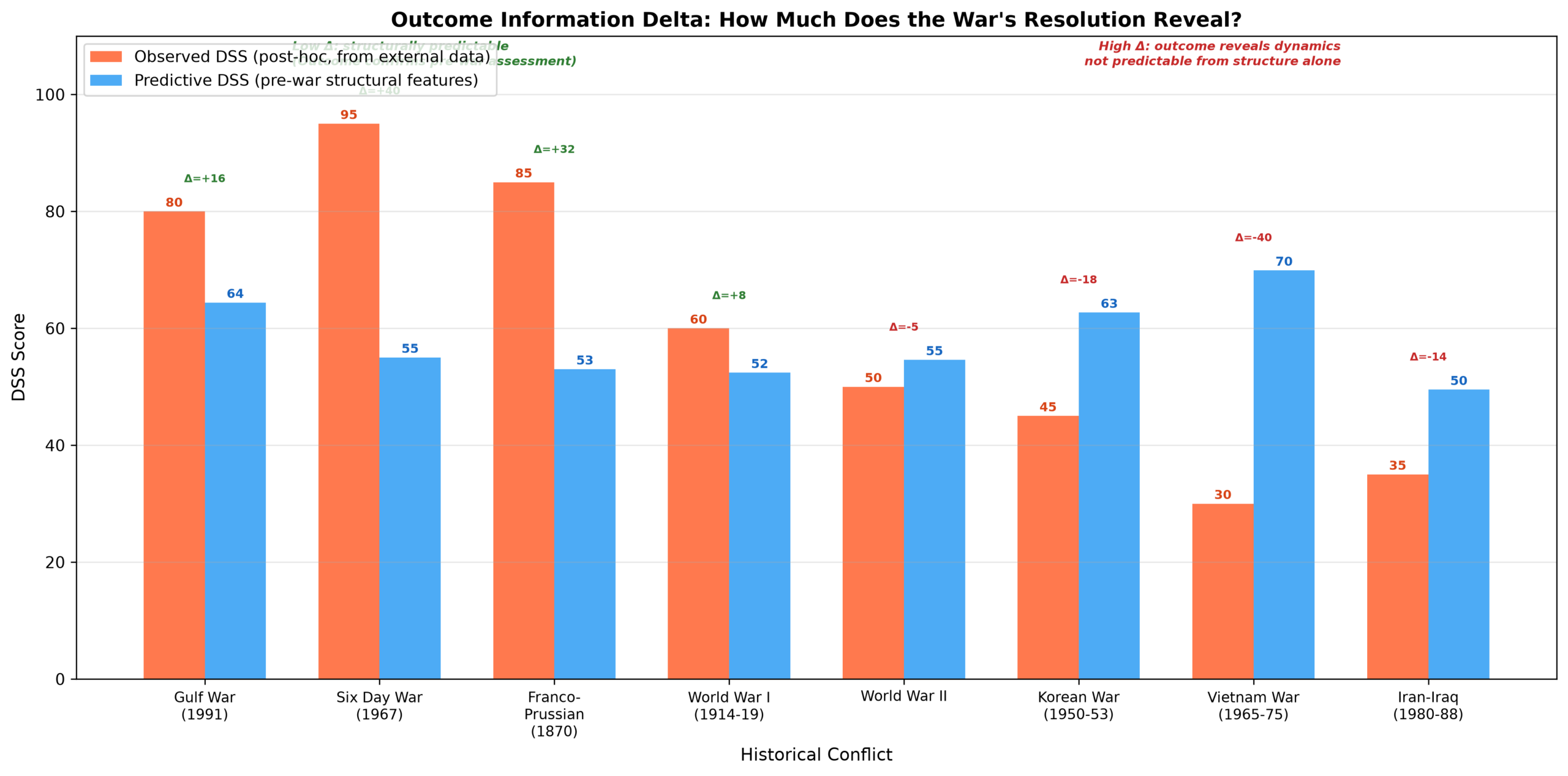
Observed DSS compared with the structural DSS proxy. Large gaps show where the outcome changed the story that could have been told before the war.
The simulation
The simulation is a bounded, discrete-time model. Each time step represents one month, each side carries five normalized state variables: Military strength, economic capacity, political will, population support, and industrial capacity.
The values are indices from 0 to 100. The simulation is a state-space model designed to study trajectories. During each step, the model applies attrition, economic cost, industrial replenishment, political effects, fatigue, and small random disturbances. Shock events periodically damage military, industrial, and political capacity. Economic and political resilience change how quickly those losses accumulate. The war ends when one of several conditions is reached, including political collapse, military destruction, overwhelming dominance, mutual exhaustion, economic collapse, or negotiated settlement.
## What survived sensitivity testing
Simulation models can become elaborate ways to restate their own assumptions. We tried to make that problem visible instead of burying it. The internal coefficient audit varied 23 model coefficients by plus or minus 50 percent. Twenty-two produced no classification flips in the representative tests. The one sensitive coefficient was the battle-loss rate, and its effect was concentrated near a classification boundary.
The broader preset sensitivity tests also show that most cases remain stable. The cases that do move are the ones we’d expect to be vulnerable: conflicts near the border between mechanisms, where a small change in attrition or shock strength can change the dominant path.
The machine-learning result means less and more than it first appears
We also tested whether material-capability variables could predict whether a war would be short or long. A logistic regression using ten capability features reached 55.0 percent cross-validated accuracy, barely above the 52.3 percent majority-class baseline. A random forest using the same inputs reached 72.7 percent. It predicts war-duration category from material-capability features.
It shows that simple additive relationships miss a large part of the structure. Changes in national capability, energy consumption, military expenditure, and personnel interact in ways a straight linear model doesn’t capture.
Read the paper and run the model
Equations, data limitations, case inventories, sensitivity tests, and falsification criteria are available in the paper.
You can explore the model directly in the browser simulation. Change the parameters, run the historical presets, and look for the point where a shock stops being decisive and becomes only the final shove.