Excerpt: Denmark, Iceland, Norway, Sweden, and Finland rank among the world’s best countries for women. Their police records, however, tell a much less comfortable story about violence, reporting, and what “safe” actually means.
Are the Best Countries for Women Actually the Safest? What Police Records Show
Visual Capitalist’s map of the best countries for women places Denmark first, followed by Iceland, Norway, Sweden, Finland, Luxembourg, Belgium, the Netherlands, Austria, and New Zealand. The ranking comes from Georgetown University’s Women, Peace and Security Index. There’s nothing inherently wrong with that ranking. The index measures women’s education, employment, financial access, legal rights, political representation, health, exposure to conflict, intimate-partner violence, and perceptions of safety. But that is not the same thing as asking: In which countries are women least likely to be raped, assaulted, abused, or killed?
To answer that question, I went back through police reports, national statistical agencies, and official administrative crime data for the map’s top ten countries. I looked primarily at recorded rape and sexual violence, domestic or intimate-partner violence, and female homicide over approximately the last decade. The result is considerably different than the map.
Several of the highest-ranked countries have experienced substantial increases in police-recorded rape and sexual violence. Others changed their laws or recording systems so dramatically that a clean ten-year comparison is impossible. Some don’t publish enough sex-disaggregated crime data to support the confidence implied by an international ranking. The map may accurately identify countries where women have strong social, economic, and legal standing. It does not accurately rank the probability that a woman will become the victim of a crime.
What “actual crime reports” can and cannot tell us
A police-recorded rape exists only when several things happen:
- A victim reports the incident.
- Police accept and record the report.
- The act meets the country’s legal definition.
- The statistical system counts it as a separate offense.
- The record survives later review or reclassification.
What the national crime records show
The table below summarizes the most defensible official findings. The time periods differ because the countries don’t publish one standardized series.
| Country | Official recorded-crime evidence | Direction | Confidence in decade trend |
|---|---|---|---|
| Denmark | Recorded rape rose sharply; 2,499 women were recorded as rape victims in 2022 | Up | Medium-low |
| Iceland | Domestic-violence cases rose from 432 in 2014 to 1,058 in 2021 | Strongly up | Medium-low |
| Norway | Recorded rape increased about 40% from 2013 to 2017; 7,112 sexual offenses were reported in 2025 | Up | Medium |
| Sweden | Recorded rape rose from roughly 6,700 in 2014 to 10,014 in 2025 | Up about 50% | Medium-low |
| Finland | 1,737 women were recorded as rape victims in 2022; a 2023 legal reform breaks the trend series | Not comparable | Low |
| Luxembourg | Only limited 2018–2022 sex-disaggregated data is available | Insufficient data | Low |
| Belgium | A major 2022 legal reclassification caused an apparent decline in some sexual-violence categories | Trend break | Low |
| Netherlands | 6,240 female sexual-violence victims were recorded in 2023; 24 women were killed by intimate partners in 2022 | Serious burden, incomplete trend | Low-medium |
| Austria | Rape reports rose from 899 in 2016 to 1,275 in 2025, after reaching 1,355 in 2024 | Up 42% | High for recorded reports |
| New Zealand | Police series begins in 2014; reporting increased substantially while victimization surveys remained broadly stable | Recorded reporting up, incidence unclear | Medium |
Denmark: more recorded rape, accompanied by major reporting reforms
Denmark ranks first on the Visual Capitalist map, but its police data doesn’t show a corresponding decline in recorded violence against women. Official administrative data shows that Danish police recorded 2,499 women as rape victims in 2022. Women accounted for 92% of recorded rape victims. That year, 23 of Denmark’s 58 homicide victims were women. Police also recorded 31,580 women as victims of violent offenses, representing 54% of the total.
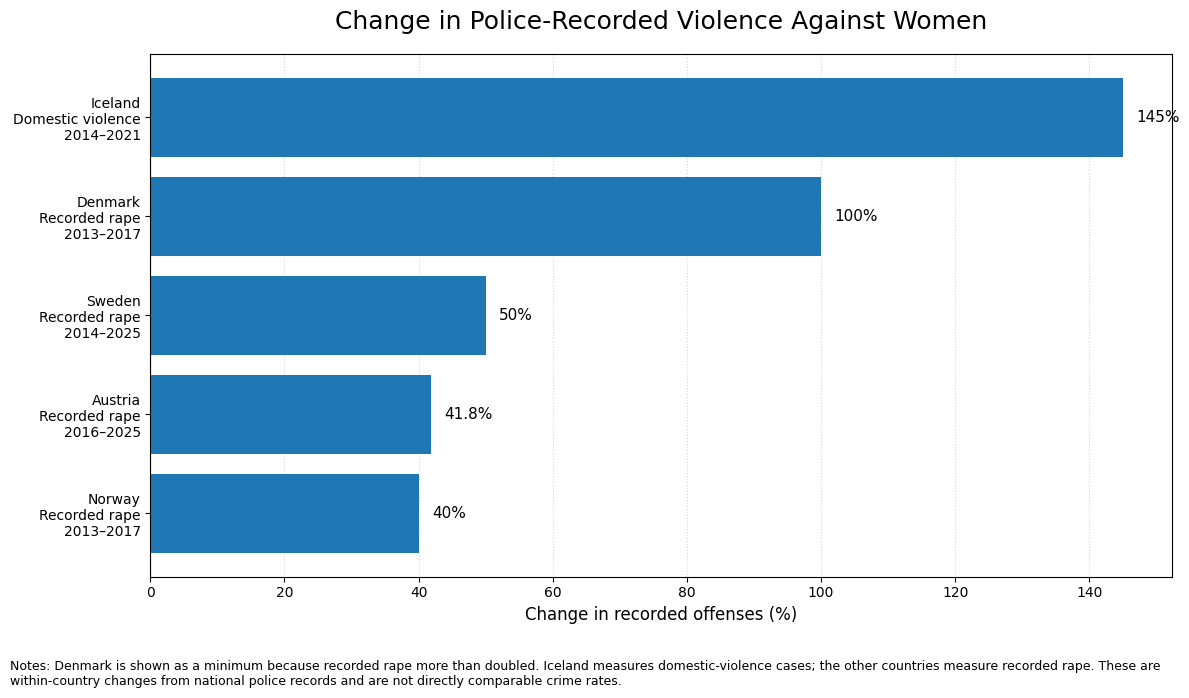
A comparative report from Sweden’s National Council for Crime Prevention found that Denmark’s reported rape total more than doubled between 2013 and 2017. Denmark may still provide excellent legal, health, educational, and economic conditions for women. Its police records don’t support the simpler claim that it is plainly the country with the least violence against women.
Iceland: domestic-violence records more than doubled
Iceland ranks second. Official Icelandic police reports show 432 registered domestic-violence cases in 2014. That rose to 800 in 2015, 895 in 2017, 935 in 2019, 1,050 in 2020, and 1,058 in 2021. From 2014 to 2021, the recorded total increased approximately 145%. Police recorded approximately 1,100 domestic-violence cases in 2023, roughly consistent with the preceding three-year average. Recorded sexual offenses followed a less linear course. Iceland registered more than 600 sexual-offense reports in 2019, 2021, and 2022. The total fell to 521 in 2023, the lowest number since 2017. Police recorded 184 rape reports in 2023, 13% below the average for the preceding three years. Women represented 84% of recorded sexual-offense victims.
Norway: rising reports, but no simple interpretation
Norway ranks third. The Norwegian police and Statistics Norway recorded 7,112 reported sexual offenses in 2025. Statistics Norway maintains a national reported-offense series and publishes victim data by sex, although classification changes associated with the 2015 Penal Code complicate some category-level comparisons. The Scandinavian comparative study found that reported rape increased approximately 40% in Norway between 2013 and 2017. Norway’s official records therefore show a substantial recorded increase, not a decade of steadily declining violence.
Sweden: roughly 50% more recorded rape than a decade ago
Sweden recorded roughly 6,700 rape offenses in 2014. In 2025, the Swedish National Council for Crime Prevention recorded 10,014 rape offenses, about 2% fewer than in 2024. That represents an increase of approximately 50% over the decade-plus period. In 2022, 94% of recorded rape offenses involved female victims. Police also recorded approximately 34,870 intimate-partner violence offenses against women and 42,024 domestic-violence offenses against women. Ten women were killed by intimate partners that year.
Finland: serious recorded violence and a broken trend line
Finland ranks fifth. In 2022, Finnish police recorded 1,737 women as rape victims. Women represented 96% of all recorded rape victims. Police also recorded 6,072 women as victims of intimate-partner violence. Women represented 80% of intimate-partner homicide victims and 65% of domestic-homicide victims in the available official data.
Finland remains one of the highest-ranked countries for women’s social status. Its official crime data, however, offers no basis for portraying violence against women as uncommon or steadily disappearing.
Luxembourg: not enough data for a ten-year conclusion
Luxembourg ranks sixth. Officially compiled police data covers only 2018 through 2022 for several relevant categories. Over that period, authorities recorded 143 women as victims of rape by any perpetrator and 59 women as victims in domestic rape cases. Women represented 77% of all recorded rape victims. Luxembourg recorded 1,095 women as victims in domestic-violence cases in 2022. Between 2018 and 2022, five women were recorded as victims of domestic homicide and ten as homicide victims overall.
Belgium: the apparent decline that was created by paperwork
Belgium ranks seventh. Belgian police recorded 39,397 intimate-partner violence offenses and 49,093 domestic-violence offenses in 2022. The records included 22,563 physical intimate-partner offenses, 16,169 psychological offenses, and 179 sexual offenses. Belgium also recorded 80 intimate-partner rape offenses and 128 domestic rape offenses. However, its administrative dataset does not provide adequate sex-disaggregated victim information for several categories. The largest trap appears in the 2022 sexual-offense figures. Recorded sexual domestic violence fell from 906 cases in 2021 to 499 in 2022. On the surface, that looks like a 45% improvement. In reality, Belgium changed its sexual criminal law and reclassified offenses, breaking the statistical series. Nothing about that decline establishes that several hundred acts of sexual violence vanished.
Netherlands: strong institutions, substantial recorded violence
The Netherlands ranks eighth. Dutch police recorded 6,240 female victims of sexual violence in 2023. Women represented 87% of recorded sexual-violence victims. Of the 2,570 identified suspects, 98% were men. In 2022, the Netherlands recorded 48 female homicide victims. Thirty-six were killed in a domestic context, and 24 were killed by an intimate partner. Those are not trivial figures, particularly for a country placed near the top of a global ranking. The available official material establishes a substantial burden of sexual and intimate-partner violence, but it does not provide a clean, harmonized ten-year sexual-violence trend in the same format used by Austria or Sweden.
Austria: one of the clearest upward police trends
Austria ties New Zealand for ninth place. Its national police report provides one of the cleaner official series in the group:
| Year | Recorded rape offenses |
|---|---|
| 2016 | 899 |
| 2017 | 817 |
| 2018 | 936 |
| 2019 | 948 |
| 2020 | 962 |
| 2021 | 1,054 |
| 2022 | 1,139 |
| 2023 | 1,287 |
| 2024 | 1,355 |
| 2025 | 1,275 |
Recorded rape increased 41.8% between 2016 and 2025. At the 2024 peak, it was 50.7% higher than in 2016. The 2025 total declined 5.9% from the previous year but remained far above the beginning of the series. Austria’s police report itself cautions that increasing reports can reflect changed reporting behavior and that international reporting propensities differ.
Austria has experienced a large increase in police-recorded rape. Whether underlying rape incidence increased by exactly the same amount cannot be determined from police reports alone.
New Zealand: reporting increased much faster than measured prevalence
New Zealand also ties for ninth. New Zealand Police introduced its current Recorded Crime Victims Statistics in 2014. Earlier police data isn’t directly comparable, limiting the available trend to roughly one decade. Official government records show 18,371 sexual-assault and related-offense proceedings between 2014 and 2024. Of those proceeded against, 97.1% were male. The most important New Zealand finding comes from comparing police reporting with national victimization data. In 2018, only about 7% of people experiencing sexual assault said at least one incident had been reported to police. In 2024, that figure was approximately 32%. The measured prevalence of sexual assault remained broadly stable while the proportion reported to police increased dramatically. That means New Zealand could experience a major rise in police-recorded cases even if the underlying number of victims didn’t rise proportionally.
Do the police reports confirm the Visual Capitalist map?
Not even close. Instead, they show:
- Recorded rape rising sharply in Denmark, Norway, Sweden, and Austria.
- Recorded domestic violence more than doubling in Iceland from its 2014 level.
- Large recorded burdens of intimate-partner violence in Finland and Belgium.
- Significant female sexual-violence totals in the Netherlands.
- Inadequate ten-year data in Luxembourg.
- Major legal or statistical breaks in Finland and Belgium.
- A large change in reporting behavior in New Zealand.
- Different definitions and counting rules in nearly every country.
he other two.ngerous than whether she left the oven on.