Operational, safety, procurement, and cost-benefit analysis


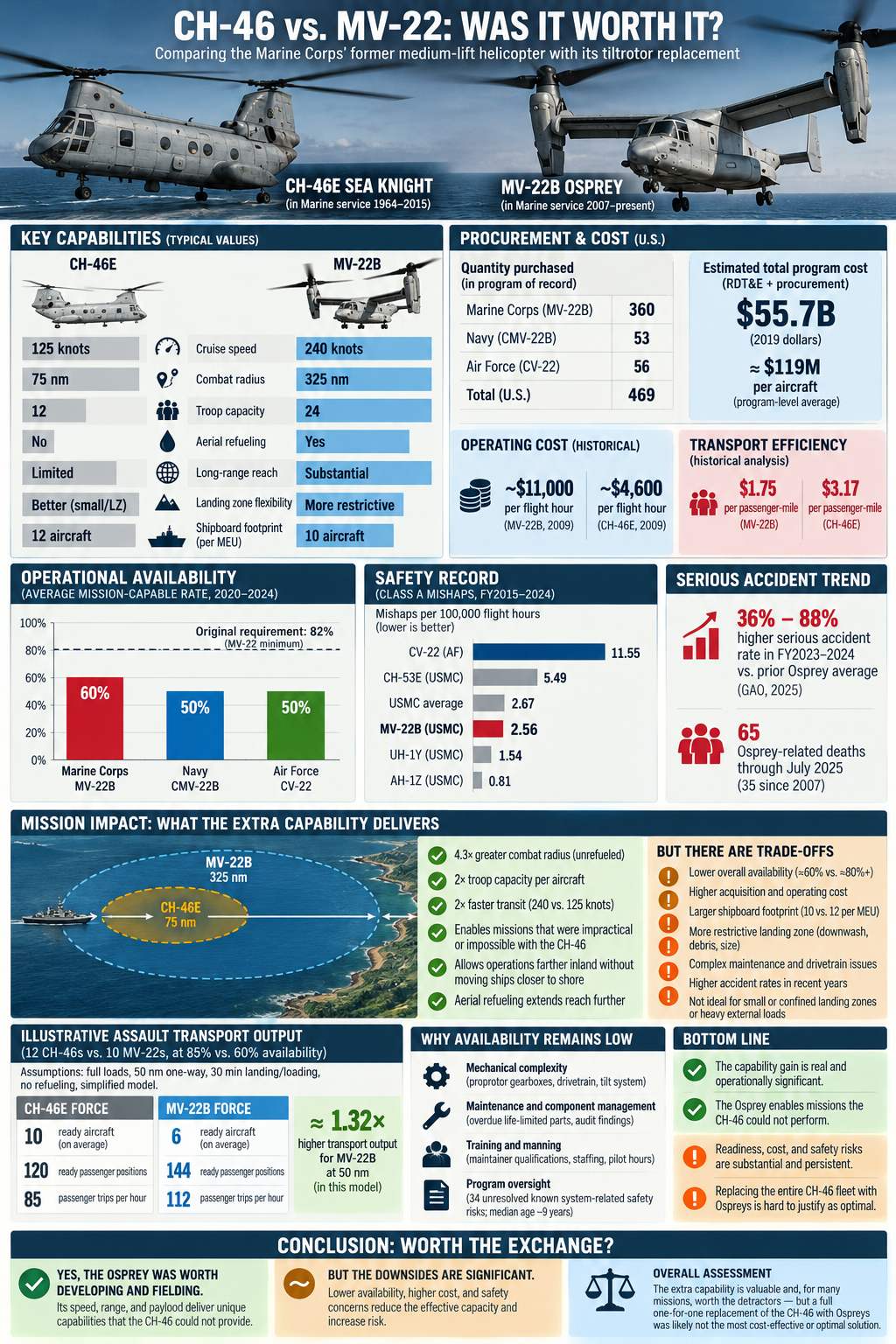
The V-22 Osprey is one of the most consequential aircraft the Marine Corps has ever fielded. It delivers capabilities that the CH-46 Sea Knight could never have provided, but at a substantial cost in procurement, maintenance, complexity, and operational risk. After analyzing the government data we came up with two important findings:
First, the performance advantage is real. The Osprey fundamentally changed the distance over which Marines could operate from amphibious ships, the speed with which they could move reinforcements, and the ability to conduct long-range operations without depending on forward helicopter bases.
Second, its safety problems are not simply media sensationalism. In December 2025, the Government Accountability Office reported that serious Osprey accident rates in fiscal years 2023 and 2024 were 36% to 88% higher than the respective services’ historical Osprey averages. The GAO also identified numerous longstanding safety problems that had not been adequately resolved.
The Osprey is clearly a better aircraft than the CH-46 in terms of raw performance. But is the additional combat capability worth it given its more expensive, maintenance-intensive, has a lower availability rate, and has additional safety risk? To find out we looked at operational output, not just published performance specifications.
1. How many Ospreys did we actually buy?
A September 2025 Congressional Research Service report instead counted 469 U.S. aircraft purchased or included in procurement plans: 360 for the Marines, 56 for Air Force Special Operations Command, and 53 for the Navy. Those quantities include aircraft not yet delivered and additional Navy procurement authority beyond the original 48-aircraft program. Japan separately acquired 17 Ospreys. The important distinction is between aircraft authorized or purchased, aircraft delivered, and aircraft remaining in the active inventory after losses. They aren’t interchangeable.
2. Operational availability: the central weakness
The Navy’s December 2025 comprehensive review provides the clearest published multiyear readiness comparison I found.
Average V-22 mission-capable rates, 2020–2024
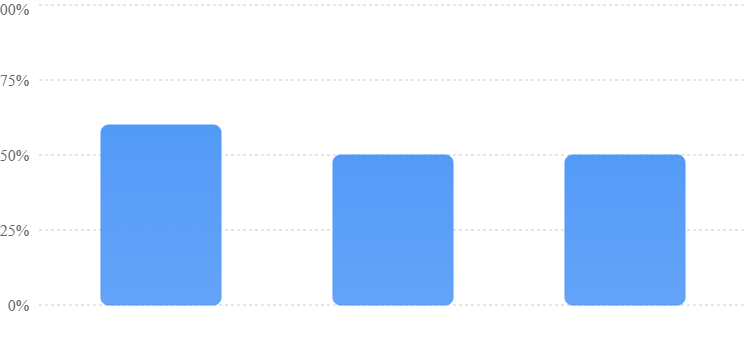
The Marine Corps aircraft averaged roughly 60% mission capable over FY2020–FY2024. For a modern primary assault-support aircraft, that is a serious shortfall.
What’s striking is how little the underlying problem has changed over nearly two decades.
| Measure | Result |
|---|---|
| Original MV-22 minimum mission-capable requirement | 82% |
| Desired mission-capable rate | 87% |
| Three Iraq squadrons, 2008-era deployments | 68%, 57%, 61% |
| Legacy helicopters in the same Iraq theater | At least 85% |
| MV-22 average, FY2020–FY2024 | Approximately 60% |
The first four figures come from GAO’s 2009 examination, while the final figure comes from NAVAIR’s 2025 review. This comparison has limitations: the early deployed squadron data and later whole-fleet averages involve different operating conditions. Nevertheless, the persistence of low availability is difficult to dismiss as merely a problem associated with introducing a new aircraft.
Mission capable also does not mean fully mission capable. An aircraft may be counted as mission capable because it can perform one authorized mission while being unable to perform another. For a mission requiring particular defensive systems, payload capability, or equipment, the number of usable aircraft can be lower.
How the CH-46 compares
The old CH-46 wasn’t maintenance-free. GAO reported that its availability was around the 80% goal during much of FY1999–FY2004, although rates were declining and its aging equipment was a growing concern. The CH-46’s age meant keeping it indefinitely wasn’t a realistic alternative. But there’s something uncomfortable about replacing an aging aircraft that could sustain relatively strong deployed readiness with a technologically advanced replacement that still averages about 60% mission capability many years into service.
3. Accident rates: separating the Marine Corps from the Air Force
This is where the data produce a more complicated picture than the Osprey’s reputation suggests. According to the Congressional Research Service, the following were Class A flight-mishap rates for FY2015–FY2024, normalized per 100,000 flight hours.
Class A flight mishaps per 100,000 hours, FY2015–FY2024, Congressional Research Service
This tells us three things.
The Marine Corps’ MV-22 is not unusually dangerous by the Class A fleetwide measure. Its 2.56 rate is slightly below the overall Marine Corps aircraft average of 2.67, and substantially below the CH-53E’s 5.49.
The Air Force’s CV-22 is a different story. Its 11.55 rate is over four times that of the Marine Corps MV-22. Air Force special operations missions can be considerably more demanding, so it would be incorrect to attribute that entire discrepancy to aircraft reliability.
The recent deterioration is nevertheless concerning. GAO’s December 2025 investigation examined the broader category of Class A and B accidents, not just Class A. It found 18 serious Osprey accidents in FY2023–FY2024 and materially higher rates than the FY2015–FY2022 baseline. The lifetime fatality record is also substantial: CRS counted 65 deaths associated with Osprey mishaps through July 2025, including 30 before initial operational capability in 2007 and 35 afterward. Twenty service members were killed in four fatal accidents beginning in 2022.
There is no directly equivalent CH-46 dataset for the same 2015–2024 period because the Marines completed their transition in 2015. So we should not claim the V-22 is definitively safer or more dangerous than the CH-46 throughout their respective service lives based on these numbers alone.
4. What capability did the extra money actually buy?
The differences between the CH-46E and MV-22B are substantial.
| Capability | CH-46E Sea Knight | MV-22B Osprey |
|---|---|---|
| Typical cruise speed | ~125 knots | ~240 knots |
| Published combat radius | 75 nautical miles | 325 nautical miles |
| Combat troop capacity | ~12 | 24 |
| Aerial refueling | No standard capability | Yes |
| Long-distance self-deployment | Limited | Substantial |
| Small landing-zone flexibility | Better | More restrictive |
| Shipboard footprint | Smaller | Larger |
Representative mission-planning values drawn from Marine Corps aircraft guidance and historical defense analyses. Radius and payload depend on fuel, altitude, weather, load, and mission profile.
The Osprey offers approximately 4.3 times the published combat radius of the CH-46. Since operational reach expands in two dimensions, the area potentially reachable from a given base increases much more rapidly than the radius itself, although real-world terrain and threat constraints reduce the theoretical advantage.
What this means in combat
Consider an amphibious force operating 100 nautical miles offshore. A CH-46 with a 75-nautical-mile combat radius cannot routinely fly an unrefueled assault mission 100 nautical miles inland from that ship. The Osprey can potentially reach a landing zone more than 200 nautical miles inland from the same ship, subject to its mission configuration.
That changes the tactical problem. Marines can maneuver farther inland without moving the ships as close to shore, potentially complicating enemy coastal defense and allowing wider dispersion of landing forces. In Iraq, GAO confirmed that the Osprey’s speed and range allowed commanders to complete missions faster and conduct some operations that had been impractical with legacy helicopters. These were actual operational benefits, not just manufacturer projections.
But there are important limitations:
- Landing-zone restrictions: Downwash, debris, exhaust, and the aircraft’s physical size can make it poorly suited to some confined or dusty locations.
- Shipboard capacity: Its larger footprint reduces the number of aircraft that can be embarked. GAO documented a historical MEU change from 12 CH-46s to 10 MV-22s.
- External loads: Sling-loaded cargo reduces the importance of airplane-mode speed and can impose different operating constraints.
- Survivability: Faster, higher-altitude transit can reduce exposure to small-arms fire. It does not make the Osprey invulnerable to modern surface-to-air missiles, and coordinating escorts can be challenging.
- High-altitude, hot-weather performance: Like helicopters, tiltrotors must contend with reduced hover performance in thin air, particularly when heavily loaded.
5. Why has reliability remained so poor?
The December 2025 NAVAIR review and GAO investigation reveal failures in both technology and maintenance management.
Mechanical complexity
The aircraft combines rotorcraft and fixed-wing systems with a sophisticated drivetrain, gearboxes, tilt mechanisms, and cross-wing power transmission. Hard-clutch engagements and proprotor gearbox failures have demonstrated that drivetrain problems can become catastrophic.
Maintenance and component management
NAVAIR’s 2025 review reported that an audit identified more than 40 life-limited safety-critical components across the fleet that had exceeded prescribed limits. This is a maintenance-control failure, not merely an unavoidable property of tiltrotor aerodynamics.
Training and manning
Investigators identified inadequate maintainer qualifications, insufficient staffing, limited pilot flight hours, and deficiencies in technical publications. Low availability reduces flying opportunities, which can compound crew proficiency problems.
Program oversight
GAO found 34 unresolved known system-related safety risks as of its review. Among 28 medium and serious unresolved risks, the median age was approximately nine years. Safety information also wasn’t being shared consistently across the three services.
The most damaging finding in the entire investigation
Allowing known serious deficiencies to remain unresolved for much of a decade suggests that the sustainment and oversight system has not kept pace with the complexity of the aircraft. NAVAIR’s December 2025 review reaffirmed the aircraft’s airworthiness under established controls and issued 32 recommendations to improve safety and readiness.
6. Financials
Historical total program acquisition estimate:
$55.7 billion
This was a December 2019 DOD estimate, including research, development, and procurement. Not a complete lifetime operating cost. Using that historical estimate against the later 469-aircraft procurement count gives approximately $119 million per aircraft in program-level acquisition spending. This isn’t the flyaway price of an individual aircraft, and the quantity and cost estimates come from different reporting dates, but it is a useful approximation of the program’s financial scale. GAO found in 2009 that the V-22 cost over $11,000 per flight hour, about 140% more than the CH-46E’s roughly $4,600. These are historical costs, not 2026 rates.
But, a National Defense University analysis published in 2012 examined cost per available passenger-mile using historical aircraft cost and performance data. It estimated approximately $1.75 per passenger-mile for the V-22 versus $3.17 for the CH-46. The reason is simple: higher passenger capacity and speed can offset higher hourly operating costs on sufficiently long, well-utilized missions.
That calculation also has weaknesses. It assumes available seats are used, applies historical flight-hour accounting, and doesn’t fully capture aircraft downtime, acquisition cost, or mission-specific penalties. It is evidence of potential transport efficiency, not proof that the entire program is cheaper.
7. A quantitative mission-level comparison
We can go a little further using a simplified force-level analysis. Suppose an amphibious ship group must choose between 12 CH-46s and 10 MV-22s, matching the historical aircraft complement difference GAO documented. Use an assumed 85% CH-46 mission-capable rate and 60% MV-22 rate, along with 12 and 24 combat passenger positions respectively the MV-22 model produces 1.53 more passenger trips per hour.
The Model assumes 240-knot and 125-knot transit speeds, full passenger loads, a 30-minute combined landing/loading allowance per round trip, uninterrupted round trips, and no refueling. It excludes weather, maintenance scheduling, escorts, formation assembly, aircraft losses, fuel constraints, and costs. Passenger positions are averaged over readiness probabilities, not a prediction of the exact number of aircraft ready at any moment.
This simplified model illustrates why lower aircraft availability doesn’t necessarily erase the Osprey’s operational value. At the baseline readiness assumptions, the CH-46 force has approximately 10 aircraft ready while the Osprey force has only six. Yet the Osprey force still has greater total passenger capacity per wave because each aircraft carries twice as many combat passengers in the selected configurations.
The transit-speed advantage can then allow additional sorties on longer routes. More importantly, missions beyond the CH-46’s unrefueled combat radius aren’t merely faster with the Osprey; they become newly feasible. However, a model based on transportation efficiency doesn’t tell us the cost or probability of succeeding in a contested amphibious operation. Those require more realistic mission simulations.
8. Should the Marines have selected an alternative?
The alternative was building a mixed medium-lift fleet, possibly including a conventional helicopter adapted for naval operations, while buying fewer Ospreys for missions requiring exceptional range. GAO recommended a renewed alternatives analysis back in 2009. DOD did not undertake that reassessment in the form GAO requested.
The alternatives have their own limitations. A navalized Black Hawk-type aircraft would provide less troop capacity and range. A CH-47-type solution would provide significant lift, but would require major shipboard integration and certification considerations. Neither would reproduce the Osprey’s combination of range, payload, shipboard compatibility, and vertical landing.
Still, a conventional platform could have advantages in shorter-range missions, external loads, smaller landing zones, or maintenance simplicity. A mixed fleet would introduce its own cost: separate training systems, parts inventories, qualifications, and shipboard support requirements. Therefore, the case for a mixed force is plausible, not proven.
9. Our assessment
We would separate the question into three decisions.
| Decision | Assessment |
|---|---|
| Was replacing the CH-46 necessary? | Yes. The aging aircraft had limited growth potential and increasing sustainment problems. |
| Did the Marines need the V-22’s capability? | Yes, particularly for long-range amphibious maneuver, dispersed logistics, and rapid crisis response. |
| Was replacing virtually the entire medium-lift force with V-22s the optimal acquisition decision? | Not demonstrated. Readiness, cost, and mission specialization make the case for a mixed force worthy of serious consideration. |
The strongest evidence in favor of the Osprey is that its additional capability is not incremental. It makes some missions possible that conventional helicopters could not perform without additional refueling, basing, or support. The strongest evidence against the program is that, after decades of development and nearly two decades of operational service, the Marine Corps has still struggled to achieve acceptable readiness, while serious known safety problems have persisted for years.
Our conclusion: The Osprey was worth developing and fielding, but the decision to make it the Marine Corps’ nearly exclusive medium-lift assault-support platform is much harder to justify. Its capabilities are valuable enough to retain. The data do not demonstrate that buying the full fleet was the most cost-effective way to provide those capabilities.
At this point, with production substantially complete, we wouldn’t recommend wholesale replacement. That would discard an enormous existing investment and create another acquisition and transition problem. Instead, we would require measurable recovery in mission-capable rates toward the original 82% requirement, validated resolution of critical drivetrain failures, improved maintenance staffing and serialized-part tracking, and independently assessed mission effectiveness. Analysis to determine future conventional medium-lift capacity to complement the Osprey in roles where speed and range offer relatively little benefit should be done.
There is an important distinction between an aircraft that is technologically successful and a procurement program that is economically and operationally optimized. The V-22 convincingly demonstrates the former. After reviewing the GAO, NAVAIR, CRS, and Marine Corps evidence, we don’t think the record conclusively establishes the latter.