There’s substantial evidence of a relationship, including a newly published 2026 academic study that directly addresses CAFE standards causing more defects. The evidence suggests that pressure to improve fuel economy can lead manufacturers to adopt more complicated engine technologies, potentially increasing mechanical failures, safety defects, and recalls. The important distinction is between three propositions:
- Higher fuel economy is associated with more defects. A recent study found a statistically significant relationship.
- Tighter federal standards encouraged manufacturers to adopt technologies associated with those defects. There is evidence supporting this mechanism.
- CAFE regulations caused the overall historical increase in automotive defects. This broader conclusion has not been established, because recalls and reliability have also been influenced by electronics, manufacturing practices, regulatory enforcement, and other developments.
1. A 2026 study found a surprisingly large relationship
A research paper published July 14, 2026, in Production and Operations Management is particularly relevant: Safety Defects and Fuel Efficiency in the Automotive Industry Researchers Donggyu Jeon, George P. Ball, and Gilvan C. Souza analyzed 643 distinct vehicle model–engine combinations from 18 manufacturers across 18 years, comparing fuel economy with 19,785 reported safety defects. There was a +17.5% associated change in safety defects for each additional MPG, as estimated by the researchers and 19,785 reported safety defects examined.
The researchers also reported that higher MPG was associated with more safety recalls, lower J.D. Power quality and reliability ratings, and defects appearing at lower vehicle mileage. Their additional analysis linked a 2011 federal fuel-efficiency policy change to greater adoption of fuel-saving engine technologies and subsequently more defects. Sage Journals.
2. The historical tightening of CAFE standards
CAFE began with the Energy Policy and Conservation Act of 1975. The first passenger-car standards applied to model year 1978. Requirements subsequently increased, plateaued, and then began another major increase in the 2010s.
U.S. passenger-car CAFE requirements, 1978–2024 Regulatory miles per gallon, not real-world fuel economy. Selected milestone years.
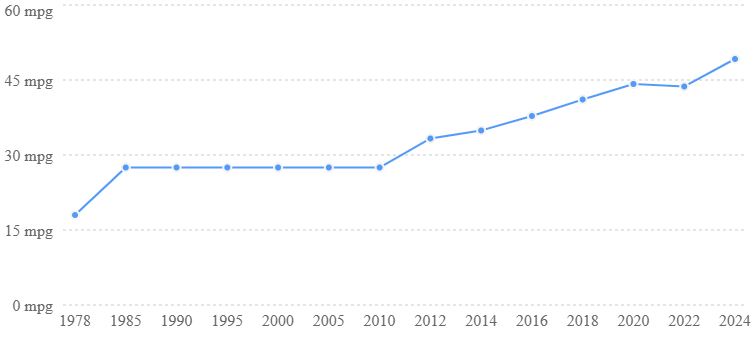
Source: U.S. Department of Energy, CAFE Requirements by Year. From 2011 onward, the figures represent estimated fleet requirements under footprint-based rules, not identical requirements for every vehicle.
| Period | Federal requirements | Industry response |
|---|---|---|
| 1978–1985 | Cars: 18 → 27.5 MPG | Smaller, lighter cars; drivetrain redesign |
| 1985–2010 | Cars largely fixed at 27.5 MPG | Performance, vehicle size, electronics and equipment increased |
| 2011–2016 | Cars: 30.4 → 37.8 MPG | Greater emphasis on advanced powertrains |
| 2017–2020 | Cars: 39.6 → 44.2 MPG | Turbocharged engines, direct injection, advanced transmissions |
| 2021–2024 | Cars: 43.7 → 49.2 MPG | Continued engine optimization, hybridization and electrification |
The early 1980s and post-2011 periods represent two distinct episodes of substantial fuel-efficiency pressure. One difference, the 1970s standards encouraged manufacturers to reduce vehicle weight and size, while modern standards increasingly rely on technological changes to engines, transmissions, and electrical systems. The EPA reports that new-vehicle weight dropped approximately 21% between 1975 and 1981, influenced by both CAFE requirements and gasoline prices. Since 2004, however, average vehicle fuel economy, weight, and horsepower have all increased together.
3. Comparing CAFE standards with the historical recall record
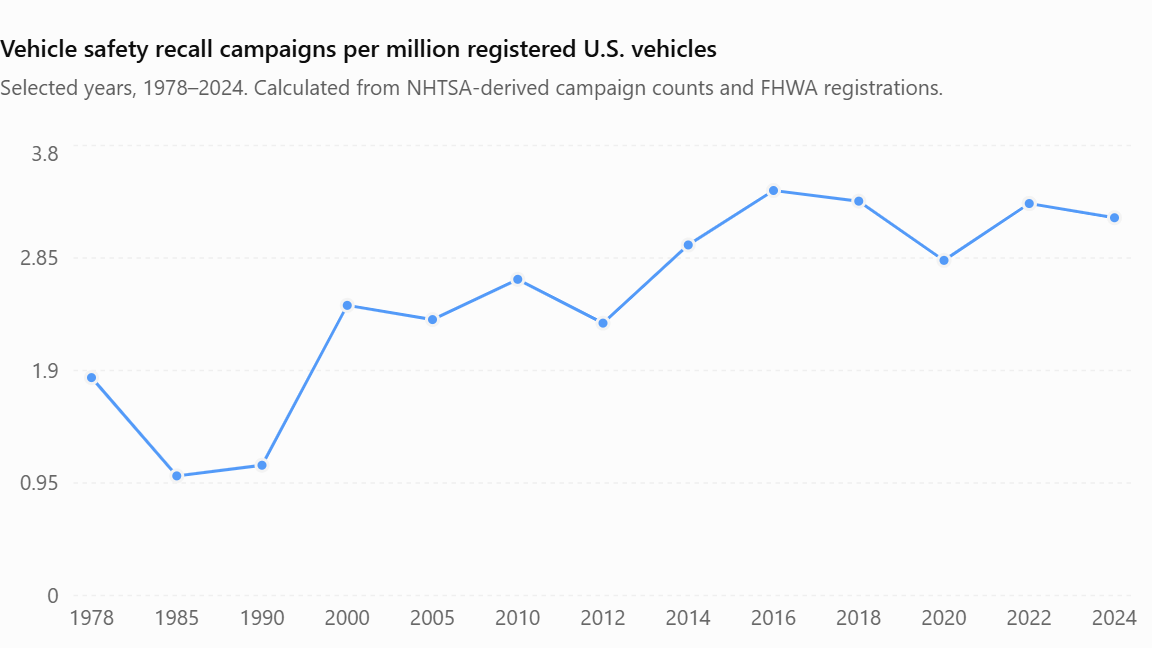
To examine the relationship, we compared the Department of Energy’s historical passenger-car CAFE requirements with NHTSA-derived vehicle recall campaign counts and Federal Highway Administration vehicle registration totals. Because the number of registered vehicles has increased substantially, we divided annual recall campaigns by the size of the registered fleet. This is a rough normalization, not a measured probability that an individual vehicle develops a defect.
Vehicle safety recall campaigns per million registered U.S. vehicles, selected years, 1978–2024. Calculated from NHTSA-derived campaign counts and FHWA registrations.
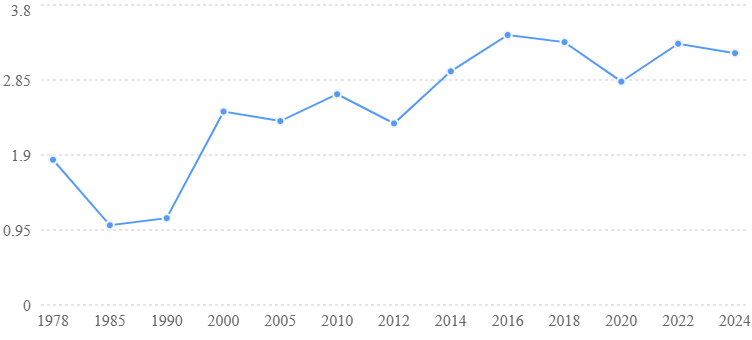
The calculations used NHTSA-derived vehicle recall counts and FHWA historical registrations. This is an exploratory comparison of broad vehicle populations, not a passenger-car-only defect analysis.
Here are the underlying observations for several useful comparison years:
| Year | Car CAFE target | Recall campaigns | Campaigns per million registered vehicles |
|---|---|---|---|
| 1978 | 18 MPG | 272 | 1.84 |
| 1985 | 27.5 MPG | 173 | 1.01 |
| 2000 | 27.5 MPG | 541 | 2.45 |
| 2010 | 27.5 MPG | 647 | 2.67 |
| 2016 | 37.8 MPG | 919 | 3.42 |
| 2024 | 49.2 MPG | 950 | 3.19 |
Defects increased even while standards were flat
Between 1985 and 2000, passenger-car CAFE requirements remained at 27.5 MPG. Yet the normalized recall-campaign measure went from approximately 1.01 to 2.45 per million registered vehicles. Between 2010 and 2024, the passenger-car CAFE target increased approximately 79%, while the same normalized recall measure increased approximately 19%.
4. Fuel efficiency versus reliability
Meeting those targets changes the engineering of the vehicle. The EPA reports that more than 44% of new vehicles produced in model year 2024 used gasoline turbocharged engines, while stop/start systems appeared in 58% of gasoline non-hybrid vehicles. These technologies can help improve fuel economy, but they also introduce additional components, operating demands, and possible failure mechanisms.
| Fuel-saving technology | Benefit | Potential reliability tradeoff |
|---|---|---|
| Smaller turbocharged engines | Lower displacement with retained power | Greater thermal and cylinder-pressure demands; added turbocharger hardware |
| Gasoline direct injection | Precise combustion and improved efficiency | Intake-valve deposits and fuel-system problems |
| Cylinder deactivation | Less fuel consumed under light load | Additional actuators, controls and operating transitions |
| Stop/start systems | Reduced idling consumption | More frequent restart cycles and greater dependence on supporting electrical systems |
| CVTs and multi-speed transmissions | More efficient engine operation | More complicated control and mechanical systems |
There are documented engineering mechanisms behind the concern. SAE research identifies intake-valve deposit formation as a problem in gasoline direct-injection engines, while research into turbocharged, downsized engines documents low-speed pre-ignition that can damage pistons, piston rings, and other internal components.
5. Defects unrelated to CAFE
The Takata airbag recalls and GM ignition-switch recalls affected millions of vehicles without directly involving fuel-economy technology. They also influenced the historical recall record. Electronics are another important factor. J.D. Power’s 2026 Vehicle Dependability Study reported 204 problems per 100 three-year-old vehicles, up from 202 in 2025. Infotainment was the largest problem category, at 56.7 problems per 100 vehicles. Those problems cannot reasonably be attributed wholesale to CAFE.