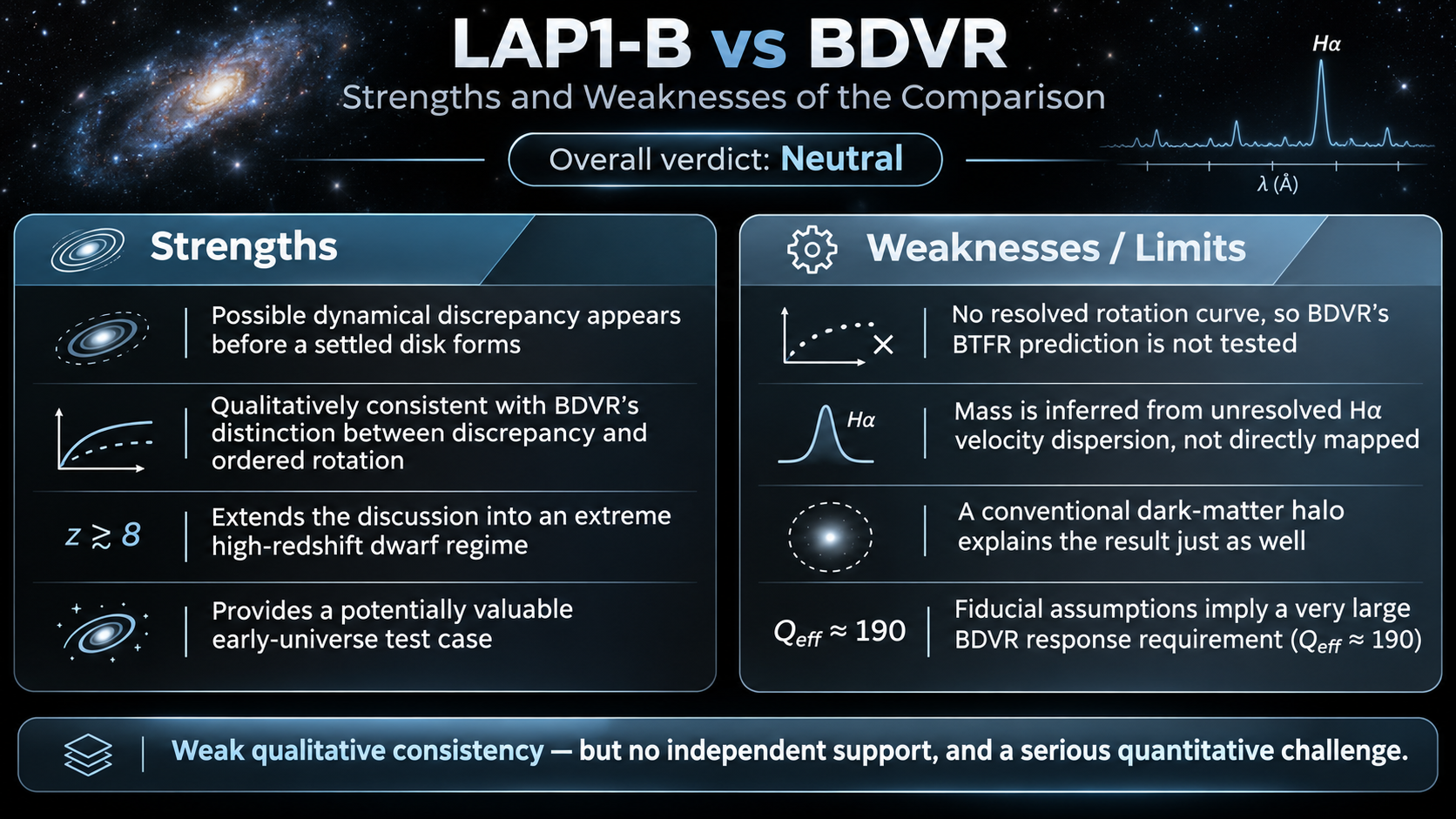
An extraordinarily primitive galaxy, observed just 800 million years after the Big Bang, offers a remarkable opportunity to examine whether the gravitational discrepancies attributed to dark matter might arise before galaxies develop the organized rotation we observe today.
A study published in Nature on May 13, 2026, by Kimihiko Nakajima and colleagues, describes the discovery of LAP1-B, an extraordinarily faint and chemically primitive galaxy observed by the James Webb Space Telescope (JWST). The galaxy appears to be in one of the earliest stages of star formation, with remarkably little stellar mass and almost none of the heavier elements produced by successive generations of stars. Yet its gas exhibits motions that, if interpreted as gravitationally supported, imply a total mass more than a hundred times greater than its estimated baryonic mass.
The discovery is particularly interesting in the context of my Bound Domain Vacuum Response (BDVR) hypothesis, which proposes that the dynamical discrepancies conventionally attributed to dark matter may exist independently of a galaxy’s degree of rotational organization, while the emergence of stable, ordered disks determines how consistently those discrepancies appear in observed rotation velocities.
After examining the LAP1-B discovery paper and comparing its findings with the predictions and limitations of BDVR, my conclusion is that the discovery does not refute the hypothesis and is qualitatively consistent with part of its proposed behavior. But the observations do not support a vacuum-response interpretation over conventional dark matter, and the extraordinary inferred mass discrepancy raises a quantitative challenge.
A Galaxy Barely Beginning to Form Stars
LAP1-B is located at a spectroscopic redshift of 6.625, corresponding to a time when the universe was approximately 800 million years old. Its light has been greatly magnified by the gravitational lensing effect of the foreground galaxy cluster MACS J0416, allowing JWST to examine a system that would otherwise be far too faint for detailed spectroscopy.
The galaxy’s oxygen abundance is approximately 0.42 percent of the solar value, making it the most chemically primitive star-forming galaxy identified at the time of the study. Its spectrum also contains evidence of an exceptionally energetic ionizing radiation field and an unusual carbon-to-oxygen abundance ratio, both consistent with stellar populations formed under conditions resembling those of the universe’s earliest generations of stars.
Perhaps more remarkable is how little stellar material the galaxy contains. The researchers estimate an upper limit of just 3,300 solar masses in stars, while the gas mass is estimated at approximately 100,000 to 500,000 solar masses. In other words, this is a system overwhelmingly dominated by gas, with only a tiny fraction of its available baryonic material converted into stars.
The important observation for gravitational dynamics comes from the broadening of the hydrogen-alpha emission line. The researchers measure a gas velocity dispersion of 58.3 ± 17.8 kilometers per second, which they interpret using a virial mass estimator and an assumed characteristic radius of approximately 10 parsecs. Their resulting dynamical mass estimate is approximately 27 million solar masses, compared with a corresponding gas mass estimate of about 230,000 solar masses.
If these estimates accurately describe a gravitationally supported system, the implied dynamical mass is roughly 117 times the estimated baryonic mass. The authors interpret this discrepancy as evidence that LAP1-B is embedded within a dominant dark matter halo, despite having formed very few stars.
The chemical evidence is also significant. LAP1-B resembles the likely progenitors of the ultra-faint dwarf galaxies observed in the nearby universe, whose ancient stellar populations and large inferred mass-to-light ratios have made them important subjects in dark matter research. This may be an opportunity to observe an ancestral version of those systems while its star formation and chemical enrichment are still underway.
BDVR
The BDVR framework distinguishes between the existence of a dynamical response beyond the Newtonian prediction for baryonic matter and the organization required for that response to appear as stable, approximately axisymmetric disk rotation.
This distinction is central to the hypothesis. BDVR does not require every galaxy exhibiting a dynamical discrepancy to occupy the baryonic Tully–Fisher relation (BTFR), which describes the remarkably close relationship between the baryonic mass of rotationally supported galaxies and their characteristic rotation velocities. Gas-rich, irregular, turbulent, or otherwise dynamically unsettled systems may exhibit an additional response without expressing it through a single, reproducible rotational velocity. As galaxies become more organized, the hypothesis predicts that their rotation measurements should converge toward a tighter BTFR-like relationship.
The researchers infer a very large gravitational discrepancy in a system containing almost no stars, yet they have not measured an organized rotating disk or established an asymptotic rotation velocity. The available kinematic information comes from an unresolved emission-line width rather than the kind of spatially resolved rotation curve used to investigate nearby disk galaxies.
The inferred discrepancy is therefore compatible with the BDVR proposition that an additional dynamical response need not depend on the prior establishment of orderly disk rotation. However, compatibility is not confirmation. The observation cannot determine whether such a response exists, much less whether the response originates in vacuum dynamics rather than an unseen matter component.
More importantly, the central statistical prediction in my BDVR paper concerns the relationship between disk organization and scatter around the BTFR. As rotational organization increases, the hypothesis predicts that the residual variance should decrease after accounting for mass, observational uncertainties, and other relevant influences. A single object without a measured rotation curve cannot test this relationship.
The preliminary BDVR analysis of nearby SPARC and xGASS galaxies found lower observed BTFR scatter among galaxies ranked highest by exploratory organization proxies. However, much of that association was attributable to inclination, spectral linewidth, and measurement recoverability, rather than independently established physical organization. The paper consequently calls for resolved kinematic observations before interpreting the pattern as evidence of a new dynamical response.
LAP1-B does not change that conclusion, although it extends the discussion into an observational regime far removed from the relatively mature galaxies used in the original analysis.
The Quantitative Problem: An Enormous Inferred Response
The most interesting challenge raised by LAP1-B is not simply that its inferred dynamical mass exceeds the visible mass, since this is familiar territory in galactic dynamics. The difficulty is the extraordinary magnitude of that discrepancy within such a compact and primitive system.
The BDVR paper introduces a phenomenological acceleration response of the form:
a_resp = Q_eff √(a_bar a₀)
Here, a_bar represents the Newtonian acceleration predicted by the baryonic matter, a₀ is a characteristic acceleration scale, and Q_eff is a dimensionless response factor that may depend on radius and galaxy-level structural properties.
Using the discovery paper’s approximate 10-parsec model, a baryonic mass of 230,000 solar masses produces a characteristic Newtonian acceleration of approximately 3.2 × 10⁻¹⁰ meters per second squared. The inferred dynamical mass of 27 million solar masses corresponds to a gravitational acceleration of approximately 3.8 × 10⁻⁸ meters per second squared at the same radius.
Adopting an illustrative characteristic acceleration of a₀ = 1.2 × 10⁻¹⁰ meters per second squared, reproducing this discrepancy through the BDVR response equation would require a dimensionless response coefficient of approximately:
Q_eff ≈ 190
That is an exceptionally large response factor. This calculation should not be mistaken for a formal test or falsification of BDVR. The existing formulation does not establish a universal value or upper limit for Q_eff, and the comparison assumes that the equilibrium response equation can be applied to a compact, turbulent, star-forming object. It also treats the dynamical mass inferred from velocity dispersion as an effective gravitational mass within the adopted radius, which is not equivalent to directly measuring a circular acceleration.
Nevertheless, the result identifies a meaningful constraint on any future development of the hypothesis. If BDVR is to provide a physically useful alternative explanation for galactic mass discrepancies, it must eventually explain why a primitive system would exhibit such a large response without relying on an arbitrary adjustment of its coupling coefficient.
Allowing Q_eff to assume whatever value reproduces the observation would make the model flexible enough to accommodate the result, but that flexibility alone would provide little evidence for its underlying mechanism. A successful physical explanation would need to connect the response to independently measurable conditions and recover the much more regular relationships observed in mature galaxies.
Does LAP1-B Actually Demonstrate the Presence of Dark Matter?
JWST measures the galaxy’s emission spectrum, including the broadening of the hydrogen-alpha line. The dynamical mass is then calculated using a virial relationship of the form:
M_dyn = Cσ²r / G
Here, σ is the measured velocity dispersion, r is an assumed characteristic radius, and C is a structural coefficient determined by assumptions about the system’s geometry and mass distribution.
The researchers use C = 3.4 for their principal estimate and examine alternative structural assumptions, which generally produce even larger inferred masses. Their analysis therefore makes a reasonable case for a substantial mass discrepancy within the adopted gravitational interpretation.
The difficulty is that LAP1-B is a very young, actively star-forming object whose internal velocity field has not been spatially resolved. In such an environment, turbulent gas motions, stellar feedback, outflows, unresolved emitting regions, and departures from dynamical equilibrium can complicate the relationship between observed spectral broadening and the gravitational potential.
The authors acknowledge uncertainties associated with the system’s structure and unresolved kinematics. Their tests of alternative structural coefficients strengthen the inferred discrepancy within a virial framework, but they do not independently establish that every component of the measured velocity dispersion is gravitational.
Conventional cosmological models already provide plausible explanations for primordial dwarf galaxies forming within dark matter halos, and the discovery is consistent with that framework. Rather, it illustrates why a measured velocity dispersion and an inferred gravitational mass should not be confused with a direct detection of the physical substance responsible for the acceleration.
If the inferred mass is reliable, LAP1-B presents evidence for a very substantial gravitational discrepancy. The observation alone does not establish whether that discrepancy originates in dark matter, an alternative gravitational response, or some combination of physical and kinematic effects.
What This Means for Future BDVR Research
The appropriate use of LAP1-B in the BDVR research program is as an extreme high-redshift mass-discrepancy candidate, but doesn’t confirm vacuum response. An initial investigation would examine the sensitivity of the dynamical mass estimate to non-equilibrium gas motions and compare the inferred mass distribution with predictions from conventional early-galaxy halo models. The BDVR response requirements could then be calculated across the 5-, 10-, and 20-parsec cases explored in the discovery paper, including observational and structural uncertainties. That comparison would establish whether the present phenomenological response law can accommodate the inferred dynamics under physically meaningful restrictions.
References
Nakajima, K., Ouchi, M., Harikane, Y., et al. (2026). An Ultra-Faint, Chemically Primitive Galaxy Forming in the Reionization Era. Nature, 653, 363–367.
Read the Nature paper | Open-access arXiv version
Enholm, J. (2026). Disk Organization and BTFR Scatter: A Preliminary Test of the Bound Domain Vacuum Response Hypothesis.
Read the BDVR research paper and explore the project repository