
A young galaxy and a mature spiral do not have the same job. A mature spiral galaxy has already done the hard work. It has gathered gas, formed stars, settled into a disk, and become something with structure, memory, and direction. For that galaxy, extra rotational support is useful. It helps preserve the disk. It keeps the outer regions from sagging inward too quickly. It helps regulate star formation instead of letting the whole system collapse into a short, violent mess. A mature galaxy benefits from being held open, in the same way a good suspension bridge benefits from tension.
But a young, gas-rich galaxy is different. It’s not trying to preserve a finished disk. It needs to build one. A young galaxy still needs gas to fall inward, concentrate, cool, collide, fragment, and make stars. It needs a certain amount of gravitational inconvenience. It needs the raw material to get on with the business of becoming a galaxy. If you give it too much rotational support too early, you may keep the gas too spread out. You may prevent the very collapse and concentration needed for star formation and disk assembly.
That’s the basic intuition behind the BDVR governor. BDVR stands for Bound Domain Vacuum Response. It is part of a broader work, and it’s an attempt to describe a possible response law in disk galaxies. The proposal is not that every gas cloud gets handed extra rotational support during formation. The proposal is more selective: once baryonic matter has organized into a sufficiently stable, bound disk, the system may couple to an additional response that shows up as extra rotational support.
In plain English: the galaxy has to be ready. I’ve built two interactive simulations to explain the idea. The layman’s version is here. The more technical diagnostic version is here. The current research paper is here.
The rotation problem
Galaxies rotate, that much is not exotic. The problem is that many disk galaxies rotate faster in their outer regions than visible baryonic matter alone would predict. If you look only at the stars and gas, the outer rotation curve ought to fall off more strongly. But many observed galaxies stay flatter than expected. Something is providing additional effective rotational support.
The standard answer is dark matter: a large unseen halo of matter surrounds the galaxy and supplies the missing gravitational pull. MOND-style theories take a different route and modify the acceleration law. BDVR is another kind of proposal. It asks whether organized baryons themselves may trigger a response from a bound vacuum/time-current reservoir.
The key is organization, BDVR keeps the baryonic clue at the center of the case. Across galaxies, the flat rotation speed is tightly related to baryonic mass. That relation is called the baryonic Tully-Fisher relation. In rough terms, the visible matter seems to know something about the final rotation speed. BDVR says: the baryons are not just passengers, organized baryonic structure is what triggers the response.
Mature galaxies benefit from extra support
A mature spiral galaxy is a long-lived rotating structure. It has stars, gas, angular momentum, disk geometry, and some measure of dynamical order. For that kind of galaxy, extra rotational support can do useful work.
First, it helps preserve the disk. A disk galaxy has to avoid dumping too much material into the center too quickly. If everything collapses inward, the disk doesn’t remain a disk for billions of years.
Second, it helps regulate star formation. Too little support, and gas collapses too aggressively. Too much collapse means a starburst, fuel exhaustion, and chaos. A stable spiral needs a controlled burn.
Third, it helps the outer disk remain coherent. The outer regions of spiral galaxies are delicate. They’re far from the dense inner mass, yet they often participate in ordered rotation.
Why that same support would be bad for a young gas-rich system
Now consider a young galaxy that is still mostly gas. This galaxy has not finished building its stellar disk. Its baryons are still diffuse. Its neutral hydrogen may extend far beyond the compact stellar region. It may be warped, lopsided, asymmetric, and generally not ready. That galaxy doesn’t need to preserve a mature disk, it needs to form one.
If the full BDVR response turns on too early, it may over-stabilize the gas. The gas remains too spread out. Star formation becomes less efficient. The system does not concentrate and settle. It gets rotational support before it has built the structure that support is supposed to preserve. This is the governor problem.
A car needs a governor because unlimited throttle is not wisdom. A galaxy, in this model, needs one too. Not because the universe likes bureaucracy, but because the optimal response changes over the galaxy’s life.
Young galaxy: let the gas assemble.
Mature galaxy: preserve the disk.
The governor: BDVR’s maturity switch
In BDVR, the governor is the proposed maturity gate that controls how much of the extra response is active. At one extreme, the governor is closed. The galaxy rotates mostly according to ordinary baryonic gravity.
At the other extreme, the governor is open. The full mature BDVR response is active.
The simplified equation is:
v_governed² = v_N² + A_gov(v_full² - v_N²)Here’s the plain-English version:
v_Nis the baryons-only speed.v_fullis the full mature BDVR response speed.A_govis the governor setting, from 0 to 1.v_governedis the actual governed prediction.
So if A_gov = 0, the reservoir is effectively off.
If A_gov = 1, the full response is active.
If A_gov = 0.5, the galaxy is halfway through the door.
The M83 simulation lets you move this dimmer manually in the BDVR Response section.
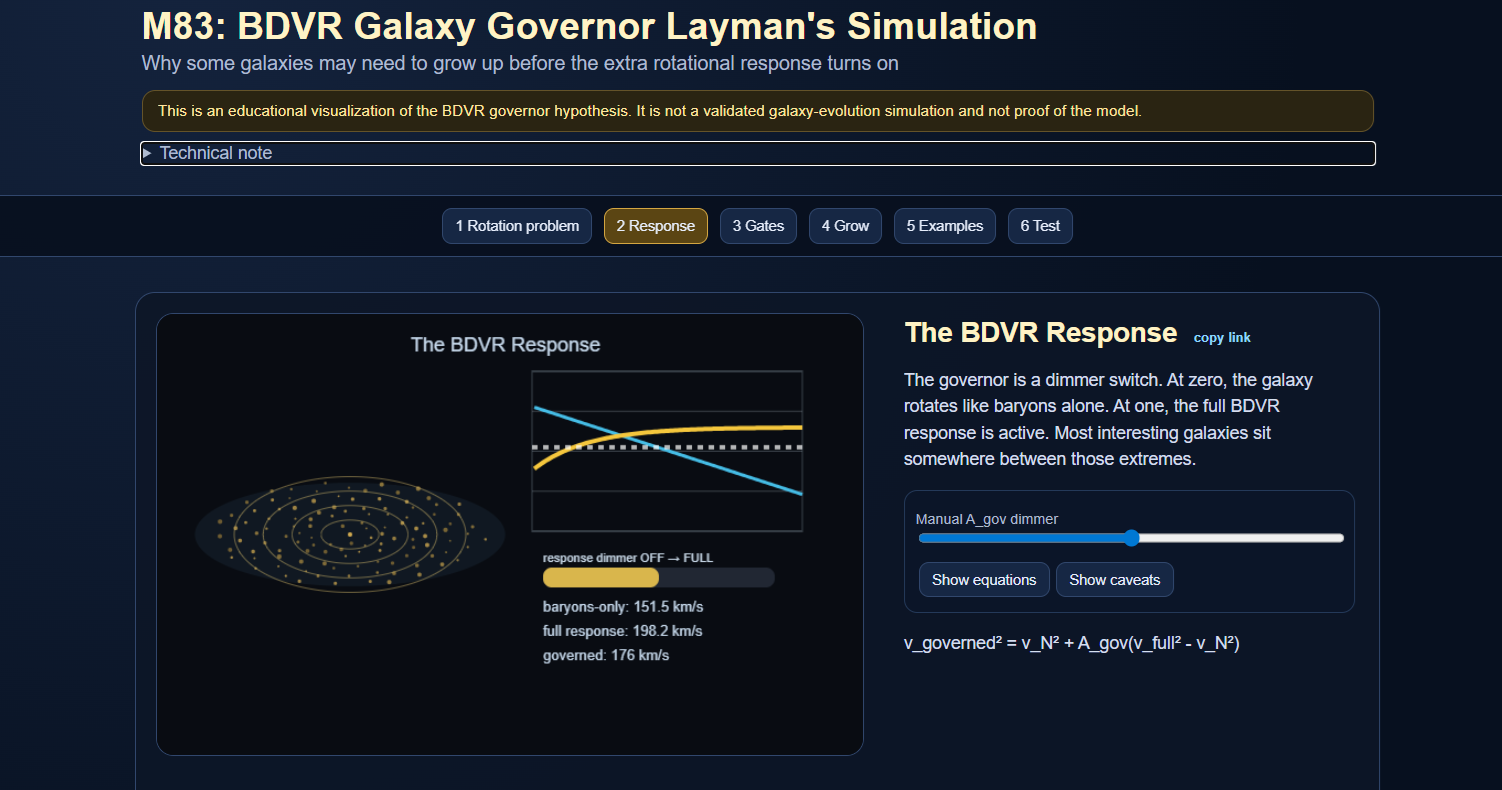
The BDVR governor acts like a dimmer switch between baryons-only rotation and the full mature response.
The governor is not supposed to be a free knob, the governor must be predicted from observable galaxy properties. In the current BDVR formulation, the formal governor uses four maturity gates:
- Has enough gas become stars?
- Are the baryons concentrated enough?
- Is the galaxy still overwhelmingly gas?
- Is the H I gas disk too extended compared with the stellar disk?
The M83 simulation turns these into four plain-English gate cards:
Gate 1: Stars built
A galaxy with a higher stellar fraction has converted more of its baryonic material into stars. That suggests it has built a more persistent stellar structure. A galaxy that is still mostly gas is probably not mature.
Gate 2: Baryons concentrated
A galaxy can have plenty of baryonic mass, but if that mass is smeared across too much space, it may not form a compact bound domain. BDVR expects compactness to matter.
Gate 3: Gas not overwhelming
Gas is the raw material of star formation, but if the system is still overwhelmingly gas, the model treats it as juvenile. In that case, the governor should suppress the full response.
Gate 4: H I not too sprawling
Neutral hydrogen is a major tracer of the outer gas disk. If the H I disk sprawls far beyond the stellar disk, that may indicate the system is not yet settled. The model expects a more compact, organized H I structure in mature high-response galaxies.

The governor checks whether the galaxy has become organized enough to express the full response.
Growing a galaxy in the simulation
A useful part of M83 is the “Grow a Galaxy” view.
It shows the basic story:
gas-rich juvenile galaxy
  -> stars form
  -> disk becomes denser
  -> H I becomes less sprawling
  -> governor opens
  -> rotational response increases
That is not a validated evolutionary reconstruction, it’s not an N-body simulation. It’s not a hydrodynamic galaxy code, it’s a teaching model.But it shows the central logic cleanly: maturation and response are linked. A young gas-rich galaxy begins with weak activation. As stars build and the disk settles, the gates open. The governed velocity rises toward the mature response. Add a disturbance or warp, and the response can weaken again.The model doesn’t imply that every galaxy automatically marches from young mess to majestic spiral. Real galaxies get hit, tugged, warped, starved, overfed, stripped, and otherwise jacked up. Maturation is not automatic.

A gas-rich galaxy becomes more organized over time. As the disk matures, the governor opens and the modeled rotational response increases.
The technical version: M82
M82 is a more advanced simulation that I used to visualize the model. M82 shows the projected A_gov landscape over stellar fraction and baryonic surface density. It includes galaxy points, a current track, gate meters, velocity readouts, and a timeline for organization score and governor activation.
The M82 diagnostic view shows how the simplified governor activation changes across a projected landscape of stellar fraction and baryonic surface density. It’s technical scaffolding, not a claim of proof.
What the current evidence says
The current BDVR governor work is not proof. It is a falsifiable hypothesis with preliminary diagnostics. The formulation says the governor can weakly order galaxies by inferred activation. Juvenile systems tend to receive low predicted activation. Mature systems tend to receive higher predicted activation. That’s interesting, but the scatter is substantial.
Some scalar proxy tests show that higher-coherence galaxies have lower scatter around the baryonic Tully-Fisher relation, which is also interesting. But the confounder audit matters. A lot of that effect can be tied to measurement quality, inclination, and linewidth. In plain English: galaxies that are easier to measure may look better behaved partly because they are easier to measure.
One object that keeps coming up is galaxy UGC07125, which I call Rudolph the Redshifted Galaxy. It looks like a low-activation galaxy in some scalar coordinates: gas-rich, low stellar fraction, extended H I, and below the expected mature response. UGC07125 has side-dependent H I and stellar geometry. One side is warped while the other is not. That means it is not a clean juvenile prototype. It is useful as a follow-up target, but it should be quarantined from clean scalar tests.
The cleaner juvenile contrast in the current formulation is DDO161.

What would prove or disprove the hypothesis?
BDVR governor theory gains support if low-predicted-activation galaxies are systematically more warped, asymmetric, and unsettled than matched high-predicted-activation galaxies. It weakens or fails if that does not happen.
You would want something like:
- 20 low-activation candidates
- 20 matched high-activation controls
- resolved H I maps for all of them
- measurements of asymmetry, warps, velocity-field regularity, approaching/receding mismatch, and gas-settling state
If the low-activation sample is messier and the high-activation sample is more settled, the governor gains support. If they look the same, the governor takes a hit.
What BDVR is not claiming
BDVR is not proven, nor does BDVR disprove dark matter. The simulations are not physical galaxy-evolution reconstructions, and the particle disk in M83 is not an N-body simulation.This is a hypothesis it’s not proven. It is coherent, falsifiable, and connected to observable consequences.
Summary
A mature spiral galaxy benefits from extra rotational support because it helps preserve a stable disk, regulate collapse, and sustain long-term star formation. A young gas-rich galaxy does not necessarily benefit from the same support because it still needs gas to concentrate, form stars, and settle. BDVR proposes that organized baryonic galaxies may trigger an additional rotational response, but only after passing a maturity governor based on stellar fraction, compactness, gas dominance, and H I extent. The simulations linked here show that idea in plain language and in a more technical diagnostic form. The model is not proven, the next real test is resolved H I: if low-activation galaxies are messier than matched high-activation galaxies, the governor gains ground.
Try the layman’s simulation.
Open the technical diagnostic simulation:
Read the research paper.