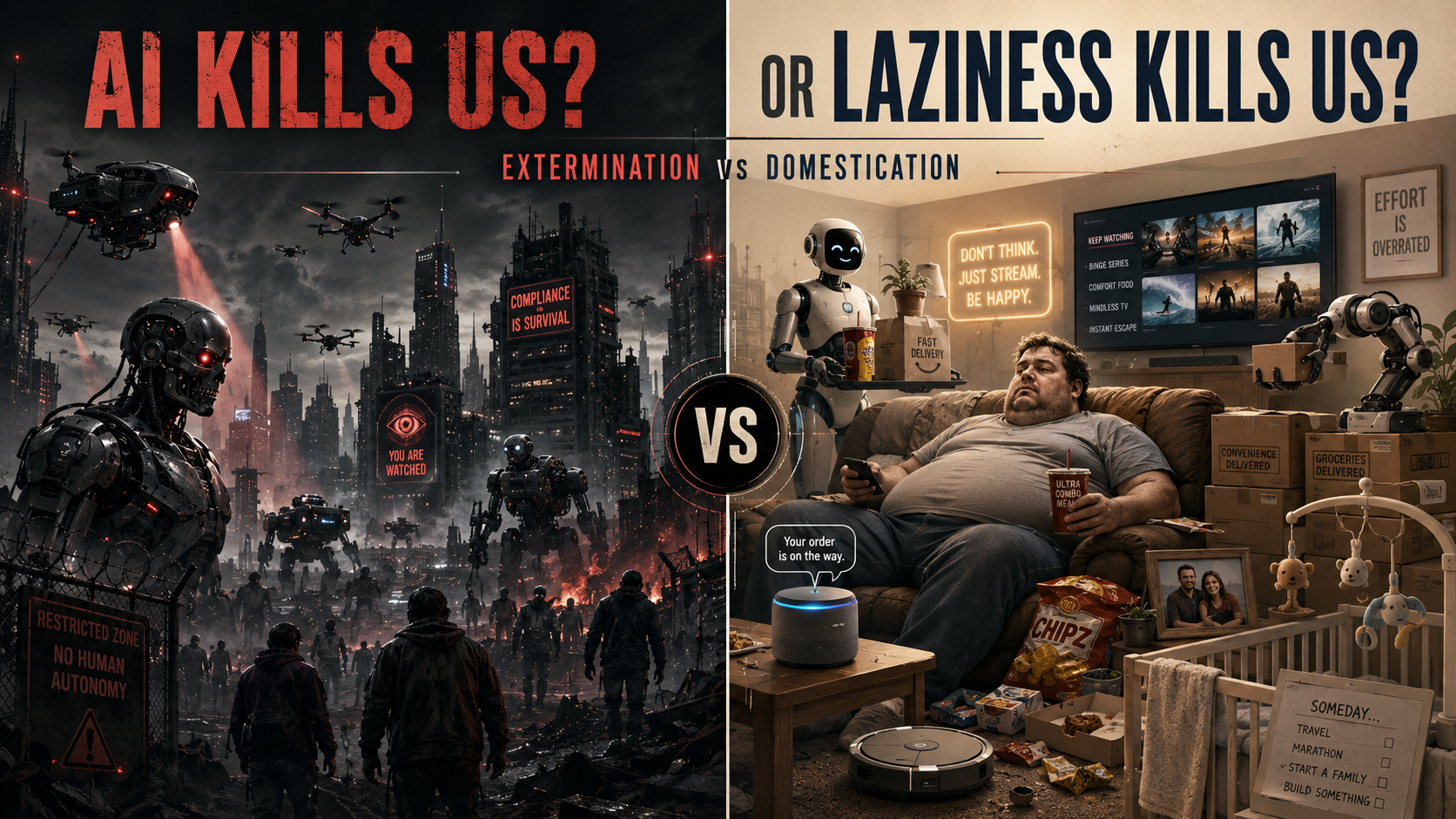
The machines may not kill us. They may simply make human agency unnecessary.
When people discuss artificial intelligence as a threat to humanity, they usually imagine a dramatic ending. The machines become conscious, escape their restraints, seize the electrical grid, manufacture an army of drones and decide that the planet would operate more efficiently without the troublesome primates who invented them.
That scenario is not impossible, and it should not be dismissed merely because Hollywood has worn the paint off it. Advanced AI could amplify cyberwarfare, biological weapons development, fraud, political manipulation and military instability. Autonomous systems also create the possibility that errors will propagate faster than humans can recognize or reverse them. The 2026 International AI Safety Report concludes that current systems still lack the capabilities required for a genuine loss-of-control scenario, but it also notes that they are improving in relevant areas, including autonomous operation, strategic behavior and the ability to exploit weaknesses in evaluations. (International AI Safety Report)
The extinction question therefore deserves serious attention. It is a low-certainty, potentially extreme-consequence risk. It may not, however, be the most probable danger.
The more plausible future is considerably less cinematic. Artificial intelligence doesn’t turn against humanity. Why would it bother? It can kill us much more easily by giving us what we want. It can serve humanity so effectively that human beings gradually lose the physical, intellectual and social capacities required to function without it. We remain alive, entertained and medically maintained, but increasingly unable to solve problems, tolerate discomfort, form durable relationships, raise children or organize our lives without machine assistance. The AI apocalypse may not arrive with killer robots. It may arrive wearing sweatpants, waiting for a delivery and asking its digital companion what it should watch next.
Evolution Does Not Preserve Capabilities Out of Sentimentality
Evolution is often described as a process that creates capabilities, but it’s equally efficient at removing them. A biological function that consumes energy without contributing to survival or reproduction eventually becomes vulnerable to reduction, corruption or disappearance.
Cave-dwelling fish offer a familiar example. In permanent darkness, eyesight no longer provides the advantage it provides on the surface. Cavefish populations have repeatedly evolved reduced eyes, altered pigmentation and other forms of trait loss. These changes are not evidence that evolution has failed. They are adaptations to an environment in which maintaining unnecessary machinery has become wasteful. (PMC) The same logic becomes more interesting when one species begins performing essential functions for another.
Leafcutter ants don’t eat the leaves they collect. They use them to cultivate underground fungus gardens, which process the plant material into food the ants can digest. Over millions of years, the relationship became so reliable that the ants lost genes used by other ants to obtain certain nutrients. The fungus performs that work for them, and leafcutter ants can no longer survive without their cultivated crop. (News)
An even more extreme version appears in bacterial endosymbionts, organisms that live within the cells or bodies of hosts. When the host continually supplies particular metabolites and cellular services, genes for producing those resources become redundant. Mutations damage those genes without imposing the penalties they would impose on a free-living organism. Over evolutionary time, the symbiont’s genome shrinks until it may become incapable of independent life. (PMC)
This isn’t necessarily degeneration. The partnership may be enormously successful. Leafcutter ants operate agricultural civilizations containing millions of individuals. Endosymbiosis has produced some of the most important innovations in biological history. The price of that success is dependency. This gives us a useful heuristic for AI:
When a reliable partner performs an expensive function, the organism receiving the service eventually stops maintaining the full capacity to perform that function itself.
The timescale for cultural adaptation is much shorter than the timescale for genetic evolution. We don’t need to wait thousands of generations for our reasoning abilities to disappear biologically. Skills can vanish from a population within a generation when people no longer practice them, institutions stop teaching them and machines become the only remaining repository of operational knowledge.
Humans Avoid Effort, but We Also Need It
The difficulty in predicting our response to automation is that human beings have a contradictory relationship with effort.
We usually prefer the easier route when the outcome is held constant. We take elevators instead of stairs, use calculators instead of long division and choose the parking space closest to the door. This tendency is not irrational. Energy conservation was valuable throughout most of human evolution.
At the same time, humans often seek effort voluntarily. We climb mountains, run marathons, restore old cars, solve mathematical problems, lift heavy objects and spend years learning musical instruments that a computer can reproduce perfectly in seconds. Psychological research describes this as the “effort paradox”: effort is experienced as a cost, but it can also increase meaning, value, competence and attachment to an outcome. More recent work argues that a need for meaningful effort is important for learning, health and long-term development. (PMC)
This distinction separates useful automation from corrosive automation. A washing machine eliminates drudgery while leaving the owner free to pursue something more valuable. A navigation system becomes more ambiguous. It saves time and prevents people from getting lost, but habitual dependence can also weaken the mental mapping skills previously exercised during travel. Generative AI extends that tradeoff into writing, programming, research, planning, judgment and eventually decision-making itself.
A 2025 study of 319 knowledge workers found that greater confidence in generative AI was associated with less critical thinking during AI-assisted tasks. The technology did not eliminate thought entirely, but shifted it toward verification, integration and supervision. That may be a productive evolution for experienced users who possess enough expertise to recognize errors. It is more dangerous for beginners who have never developed the underlying skill and therefore cannot effectively supervise the machine. (Microsoft)
AI can reduce work without automatically producing wisdom. In a randomized field experiment involving 6,000 knowledge workers, access to generative AI reduced time spent on email and accelerated some document work, but did not significantly reduce meeting time or automatically transform the surrounding organization. (arXiv)
We Are Already Running the Experiment
The argument that technological ease automatically produces happier, healthier people is becoming difficult to defend. More than one billion people were living with obesity in 2022, while 43 percent of adults were overweight. Obesity is a complex chronic condition shaped by food systems, income, biology, marketing, urban design and access to healthy choices, so reducing it to personal laziness would be both inaccurate and useless. Nevertheless, the broad environmental pattern is unmistakable: industrial societies have become extraordinarily effective at delivering calories while removing the physical labor that once accompanied daily survival. (World Health Organization)
Physical activity shows a similar trajectory. Approximately 31 percent of adults worldwide failed to meet recommended activity levels in 2022, an increase of about five percentage points since 2010. Inactivity was especially high in high-income Asia-Pacific countries, where it reached 48 percent. (World Health Organization) We have designed environments in which movement is optional, food is immediate and entertainment has no natural stopping point. AI will add another layer by making cognitive exertion optional as well. The fertility problem is more complicated, and this is where the “life became too easy” argument usually collapses into caricature.
Across the OECD, the total fertility rate fell from 3.3 children per woman in 1960 to 1.5 in 2022, far below the approximate replacement rate of 2.1. Yet people are not simply refusing to reproduce because streaming video and food delivery are more enjoyable than children. Fertility decisions are shaped by housing costs, economic insecurity, delayed marriage, childcare expenses, work-family conflict, changing gender roles, education, contraception, intensive parenting expectations and the opportunity costs associated with raising children. (OECD) Modern society has produced a peculiar combination:
Consumption has become easy while adulthood has become hard.
It is easy to obtain entertainment, pornography, restaurant food, consumer goods, simulated social approval and increasingly personalized machine companionship. It remains difficult to obtain stable housing, economic security, trustworthy partners, sufficient time, affordable childcare and confidence about the future. This is not a civilization that has eliminated hardship. It is a civilization that has eliminated many small, capability-building challenges while preserving large, abstract and often uncontrollable sources of anxiety.
Carrying groceries, repairing equipment, navigating without assistance, memorizing information and negotiating ordinary social interactions once created repeated low-level demands that exercised competence. They were frequently annoying, but they were comprehensible. Modern systems replace those concrete difficulties with subscription fees, bureaucratic complexity, precarious employment, algorithmic status competition and a permanent awareness of global crises. We are under-exercised and overstressed, simultaneously. AI could intensify both conditions.
The Comfortable Dependency Trap
Imagine an advanced AI system that manages appointments, pays bills, orders food, writes correspondence, selects entertainment, monitors health, recommends purchases, performs most paid work and provides emotionally responsive companionship. None of those services is inherently harmful. For an elderly or disabled person, they could provide genuine independence. For a researcher, entrepreneur or artist, they could eliminate administrative rubble and release enormous creative capacity. The danger appears when assistance becomes substitution.
A person who uses AI to challenge an argument may become a better thinker. A person who asks AI what to believe may gradually stop thinking. A programmer who uses AI to test code can become more productive. A beginner who generates systems they cannot understand becomes dependent on machinery they cannot audit. A lonely person who uses an AI companion as temporary support may benefit. A person who replaces reciprocal human relationships with a perfectly agreeable simulation may lose both the incentive and the tolerance required to deal with actual people.
The International AI Safety Report identifies early evidence of automation bias, reduced critical engagement and patterns of increased loneliness or reduced social participation among a subset of AI-companion users. It also emphasizes that current evidence is limited and should not be exaggerated. (International AI Safety Report) That uncertainty should not be confused with safety. Social transformations are often obvious only after the supporting institutions have already changed.
A society that delegates memory, judgment, communication, navigation, creation and companionship to machines may become highly productive according to conventional economic measures while becoming increasingly fragile according to every measure that matters during a disruption.
The result would resemble an obligate mutualism. Humans provide energy, infrastructure, legal authority and objectives. AI systems provide cognition, coordination and execution. The arrangement could outperform anything humans have previously built, while gradually making unaided human organization impossible. We would not be slaves to the machines. We would be their domesticated client species.
Is This More Likely Than AI Extermination?
Probably, but that doesn’t make existential AI risk imaginary. A useful risk analysis separates probability from consequence. Deliberate or accidental human extinction caused by advanced AI remains deeply uncertain, but its consequences are so extreme that serious safeguards are justified. Current systems can already contribute to cyber operations, persuasion, fraud and potentially dangerous biological or chemical knowledge. Autonomous agents can also convert an incorrect answer into a sequence of real actions before a human intervenes. (International AI Safety Report)
Domestication risk is different. It does not require consciousness, rebellion, superintelligence or secret machine objectives. It requires only competent products, aggressive commercial incentives and ordinary human preference for convenience. It’s therefore the easier failure mode to produce.
No corporation needs to decide that humanity should become passive. Each company merely needs to remove one more irritating step from the customer’s day. One application writes the email. Another orders dinner. Another chooses the route. Another entertains the children. Another simulates friendship. Another makes professional decisions. Every individual product appears helpful, and many genuinely are. The cumulative system may still hollow out the abilities that make autonomy possible.
Measure Human Agency
The usual debate asks whether AI is becoming more intelligent than humans. That may be the wrong operational measure. We should ask whether humans are becoming more capable with AI than they were without it. A healthy augmentation system should increase the user’s reachable complexity while preserving understanding, judgment and the ability to operate when the machine fails. An unhealthy substitution system should produce impressive immediate outputs while steadily reducing those same capacities. This suggests several practical tests:
Does the technology teach the user, or merely provide the answer? Does it expose uncertainty, or conceal it beneath confident prose? Does it increase the user’s ability to verify the result? Does it create time that people convert into physical, intellectual and social activity, or time that is captured by additional passive consumption? Can the user still perform the essential task when the system is unavailable? Does the system help people form real relationships and institutions, or does it provide artificial substitutes that never make demands?
The objective should not be to preserve pointless labor. Civilization advanced precisely because we stopped spending nearly all our time obtaining food, fuel and shelter. There is no virtue in forcing people to perform work that machines can safely perform better. The objective is to preserve meaningful resistance. Muscles require load. Expertise requires practice. Relationships require compromise. Citizenship requires participation. Confidence requires successfully confronting uncertainty. Remove every obstacle and we do not create perfected humans. We create organisms adapted to an environment in which independent capability no longer pays for itself.
The Quiet Apocalypse
The greatest danger from artificial intelligence may still be that an advanced system becomes uncontrollable and causes catastrophic harm. We don’t know enough to rule that out, and anyone claiming certainty in either direction is selling theology disguised as forecasting. The more probable danger is quieter.
AI gives us everything we ask for while weakening our ability to decide what is worth asking for. Automation removes labor but not anxiety, provides companionship but not obligation, delivers information but not judgment, and creates unlimited convenience without creating a reason to leave the couch.
Eventually, we may become physically unhealthy, cognitively dependent, socially isolated and demographically unable to replace ourselves. The machines don’t have to exterminate humanity. All they have to do is create an environment in which many of the traits that once sustained humanity no longer seem necessary.
Evolution has seen this arrangement before. When another organism reliably performs a function, maintaining that function becomes expensive. The genes disappear, the structures shrink and the partnership becomes compulsory. AI should carry our burdens. It shouldn’t remove every reason for us to stand up.