There are aircraft that look fast sitting still, and then there is the SR-71 Blackbird.
At more than 80,000 feet and Mach 3, the Blackbird operated in a part of the sky where the atmosphere was thin, the horizon curved away beneath the crew, and most fighters and surface-to-air missiles had little practical chance of catching it. In 1976 an SR-71 set an official speed record of 2,193.167 mph and an altitude record of 85,068.997 feet. From 80,000 feet its sensors could survey roughly 100,000 square miles in an hour. (Air Force Museum)
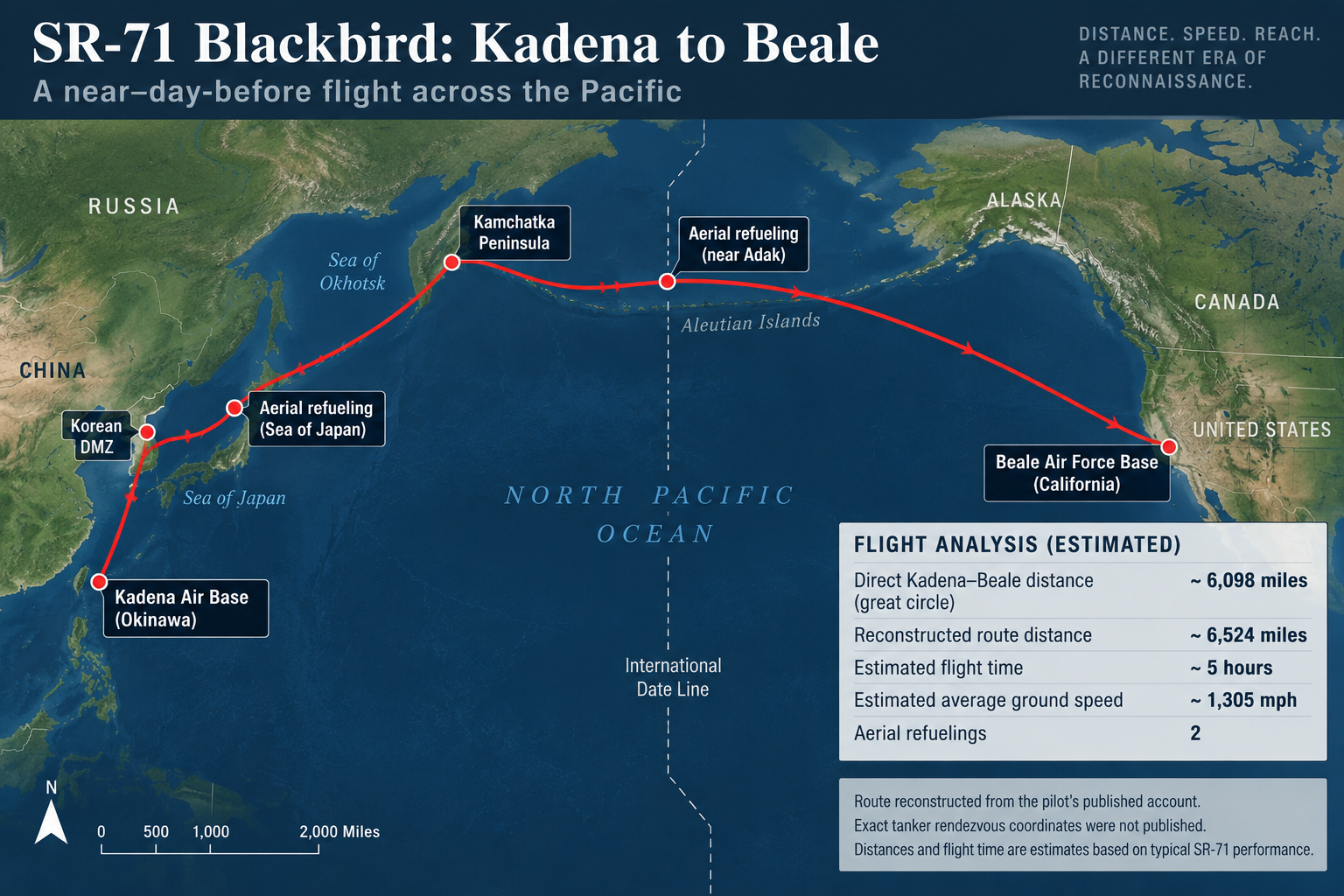
It was also an extraordinarily expensive way to take pictures. A recent 19FortyFive article recounts a flight by SR-71 pilot David Peters from Kadena Air Base in Okinawa to Beale Air Force Base in California. Peters departed at 10:00 on a Saturday morning, flew through the Korean DMZ, refueled over the Sea of Japan, continued past the Sea of Okhotsk and Kamchatka, refueled again near Adak in the Aleutians, and then crossed the Pacific to California. (19FortyFive) Another account of the same flight puts the Pacific crossing at about five hours. (19FortyFive)
Reconstructing that route gives us a good case study for something more interesting than another collection of Blackbird superlatives: what did a mission like this actually cost, and how did its return on investment compare with reconnaissance satellites? The answer explains both why the SR-71 still seems almost impossibly cool and why accountants, satellites and changing intelligence technology eventually won.
Roughly 6,500 miles in five hours
The direct great-circle distance between Kadena and Beale is about 6,100 statute miles. Peters did not fly directly. His account takes the aircraft north through Korea, across the Sea of Japan, alongside the Soviet Far East and Kamchatka, then toward Adak before turning southeast for California.Using representative points along those locations produces an estimated route of about 6,500 miles. If the published five-hour flight time is approximately correct: 6,500 miles / 5 hours = about 1,300 mph average ground speed.
The SR-71 was not traveling at Mach 3 for the entire five hours. It had to take off, climb, rendezvous with tankers, slow substantially for aerial refueling, accelerate again, descend and land. Air Force material says most SR-71 missions lasted four to six hours and required refueling about every two hours. A former SR-71 pilot’s training material describes typical tanker contact lasting 12 to 15 minutes. (AFL-CMC) So a five-hour mission with an overall average near 1,300 mph implies long portions of the flight at extraordinary speed.
That’s the part of the SR-71 story that never really gets old. You could take off from Okinawa, fly reconnaissance along some of the most sensitive territory on Earth, meet two sets of tankers over the ocean, and still be in California only a few hours later.
Estimated Peters flight
| Measure | Estimate |
|---|---|
| Direct Kadena-Beale distance | ~6,100 miles |
| Reconstructed mission route | ~6,500 miles |
| Flight time | ~5 hours |
| Average speed over reconstructed route | ~1,300 mph |
| Aerial refuelings | 2 |
| SR-71 crew | 2 |
| Likely minimum tanker aircraft | 12 |
Map caption: Estimated route of David Peters’ SR-71 flight from Kadena Air Base to Beale AFB, including the Korean DMZ, Sea of Japan, Kamchatka and Adak refueling areas. Exact tanker rendezvous coordinates and mission track were not published.
One part of the time-travel story probably isn’t right
Peters’ anecdote says that after landing, de-suiting and debriefing, the crew reached the Beale officers’ club at 4:30 p.m. Friday, supposedly 17½ hours before their Saturday departure from Japan. (19FortyFive) Crossing the International Date Line absolutely can produce the delightful experience of leaving Japan on Saturday and arriving in California on Friday. The specific 4:30 p.m. time does not work.
A 10:00 a.m. Saturday departure from Okinawa is 01:00 UTC Saturday. At that moment it is already 5:00 p.m. Friday at Beale on Pacific Standard Time, or 6:00 p.m. on daylight time. Add a five-hour flight and the aircraft should arrive around 10:00 or 11:00 Friday night, before allowing additional time for debriefing and the drive to the club. Some clock time in the retelling is therefore almost certainly wrong.
Now comes the ugly number: about $220,000 an hour in 2026 dollars
Air Force material puts the SR-71’s operating cost at $85,000 per flight hour. The source does not specify exactly which year’s dollars that figure represents, so the safest approach is to treat it as a late-1980s estimate and calculate a range. (AFL-CMC) The Consumer Price Index averaged 124.0 in 1989 and 130.7 in 1990. The July 2026 CPI-U is 333.918. (Bureau of Labor Statistics) Using 1989 dollars: $85,000 × 333.918 / 124.0 = $228,895 per flight hour
Using 1990 instead: $85,000 × 333.918 / 130.7 = $217,162 per flight hour
A reasonable 2026 equivalent is therefore about $217,000 to $229,000 for every hour the Blackbird flew. For our five-hour flight: SR-71 aircraft operating cost: approximately $1.09 million to $1.14 million. And the Blackbird has not yet received its fuel in midair.
The tanker force adds another quarter to half-million dollars
The SR-71’s speed came with enormous fuel consumption. Its global reach depended on KC-135 tankers. Former SR-71 pilot briefing material says overseas refueling points normally involved two or more tankers, partly because a single tanker might not carry enough transferable fuel and partly because the mission needed redundancy if one tanker malfunctioned. One 10.4-hour SR-71 mission with five refueling rendezvous involved 15 tankers. (Roadrunners Internationale)
Peters describes two refueling areas. Using two tankers at each gives us a conservative minimum of four tanker sorties. Without the actual mission logs, tanker flying time is the least certain part of this calculation. If those four tankers accumulated between 12 and 24 aircraft-hours supporting the mission, we can apply the Pentagon’s FY2025 reimbursable rate for a KC-135R/T of $20,063 per hour as a modern cost proxy. (Comptroller of Defense)
That produces:
| Component | Estimated cost |
|---|---|
| SR-71, five hours | $1.09M-$1.14M |
| KC-135 support, 12 tanker-hours | ~$241,000 |
| KC-135 support, 24 tanker-hours | ~$482,000 |
| Estimated airborne mission cost | $1.33M-$1.63M |
Call it about $1.5 million in 2026 dollars for the flying portion of the mission.
That estimate still leaves out some ground support, intelligence processing, mission planning, specialized maintenance and infrastructure. I would not simply add salaries on top of the aircraft hourly rates because that risks double-counting personnel already included in some cost categories. The manpower footprint was still substantial. The Air Force lists a basic KC-135 crew as pilot, copilot and boom operator. Four tankers therefore mean at least 12 tanker aircrew, plus Peters and his reconnaissance systems officer aboard the Blackbird. Some missions also carried tanker navigators. (Air Force) A two-person spy plane was really the sharp end of a much larger machine.
The annual bill hurt more than the individual mission
For an urgent national-security requirement, $1.5 million is not an absurd price. The harder number was what it cost to have SR-71s sitting there ready to perform that mission. Congressional debate surrounding the aircraft’s retirement put the operating cost of the 12-aircraft fleet at about $250 million per year in 1989-1990. (GovInfo) Converted to 2026 dollars, that becomes approximately: $639 million to $673 million every year. That’s the economic problem, the United States was deciding whether the ability to order that photograph on short notice was worth something approaching two-thirds of a billion dollars every year, before spending anything on whatever eventually replaced the aircraft. The Blackbird’s economics were closer to an insurance policy than a taxi meter. The government paid heavily for the capability to exist, then paid another million-plus dollars when it actually used it.
Satellites reverse the economics
Reconnaissance satellites have almost the opposite cost structure. They are brutally expensive to build and launch, but once one is orbiting Earth, taking another image does not require launching a Mach 3 airplane, dispatching tankers or putting aircrew near hostile territory. Exact costs of modern American intelligence satellites remain classified, so there is no honest way to produce a precise 2026 “cost per spy-satellite mission.” There is, however, a useful public historical benchmark.
A 1998 Congressional Research Service report cited estimates of $750 million to $1 billion for an advanced KH-11 reconnaissance satellite, with another $250 million to $300 million for its booster. CRS also described reconnaissance satellites as the imagery “gold standard,” while noting the limitations imposed by fixed orbital paths. (Every CRS Report) That puts satellite plus launch at roughly $1.0 billion to $1.3 billion in 1998 dollars.
The 1998 CPI-U averaged 163.0. Adjusting to July 2026 gives: Approximately $2.05 billion to $2.66 billion in 2026 dollars. That makes the satellite initially look terrible compared with a $1.5 million Blackbird sortie.
Amortizing the satellite changes everything
Because the real service lives and operating costs of classified satellites are uncertain, we modeled several lifetimes rather than pretending we know an exact number. For a $2.05 billion to $2.66 billion satellite and launch:
| Assumed useful life | Annualized capital cost | Capital cost per day |
|---|---|---|
| 3 years | $683M-$888M | $1.87M-$2.43M |
| 5 years | $410M-$533M | $1.12M-$1.46M |
| 10 years | $205M-$266M | $561K-$729K |
The five-year case is a useful middle assumption, notice what happened: the entire daily capital cost of the satellite is roughly the cost of one Peters-style SR-71 mission. If the satellite generates only one valuable mission-equivalent collection during that entire day, the cost comparison is surprisingly close. But an imaging satellite is not restricted to one target. Suppose, purely as a utilization model, that a five-year satellite produces 5, 10 or 20 useful target collections per day across all the areas its orbit permits it to observe.
| Useful collections per day | Satellite capital cost per collection | SR-71 cost advantage/disadvantage |
|---|---|---|
| 1 | $1.12M-$1.46M | Roughly comparable |
| 5 | $224K-$292K | Satellite about 5-7× cheaper |
| 10 | $112K-$146K | Satellite about 9-14× cheaper |
| 20 | $56K-$73K | Satellite about 18-29× cheaper |
| SR-71 mission | $1.33M-$1.63M | One mission |
These are not claims about actual KH-11 tasking rates. Classified satellites do not conveniently report how many “missions” they perform each day, and a satellite pass is not directly equivalent to an SR-71 sortie. The table shows the economic mechanism. A reconnaissance aircraft incurs most of its operating expense every time you use it. A satellite incurs most of its expense before you use it. High utilization therefore crushes the satellite’s effective cost per collection.
Speed had another weakness: getting the intelligence off the airplane
There is an irony buried in all this. The SR-71 might cross an ocean at Mach 3, but some of its intelligence could move much more slowly after landing. An Air Force account from former pilot Buz Carpenter describes one Middle East mission where it took 36 to 48 hours for film to be removed, transported to Washington, processed and delivered to President Carter. Carpenter specifically identified the absence of a datalink as one reason the aircraft eventually lost its advantage. (AFL-CMC)
Electro-optical reconnaissance satellites had already attacked that problem from the other direction. CRS noted that, unlike early film-return satellites, later systems could transmit imagery electronically to ground stations in real time. (Every CRS Report) That’s a brutal comparison. The Blackbird could fly faster than a rifle bullet for hours, yet a satellite moving predictably through orbit might still put usable pixels in front of an analyst sooner. The aircraft’s spectacular physical performance could no longer compensate for every limitation of the intelligence system around it.