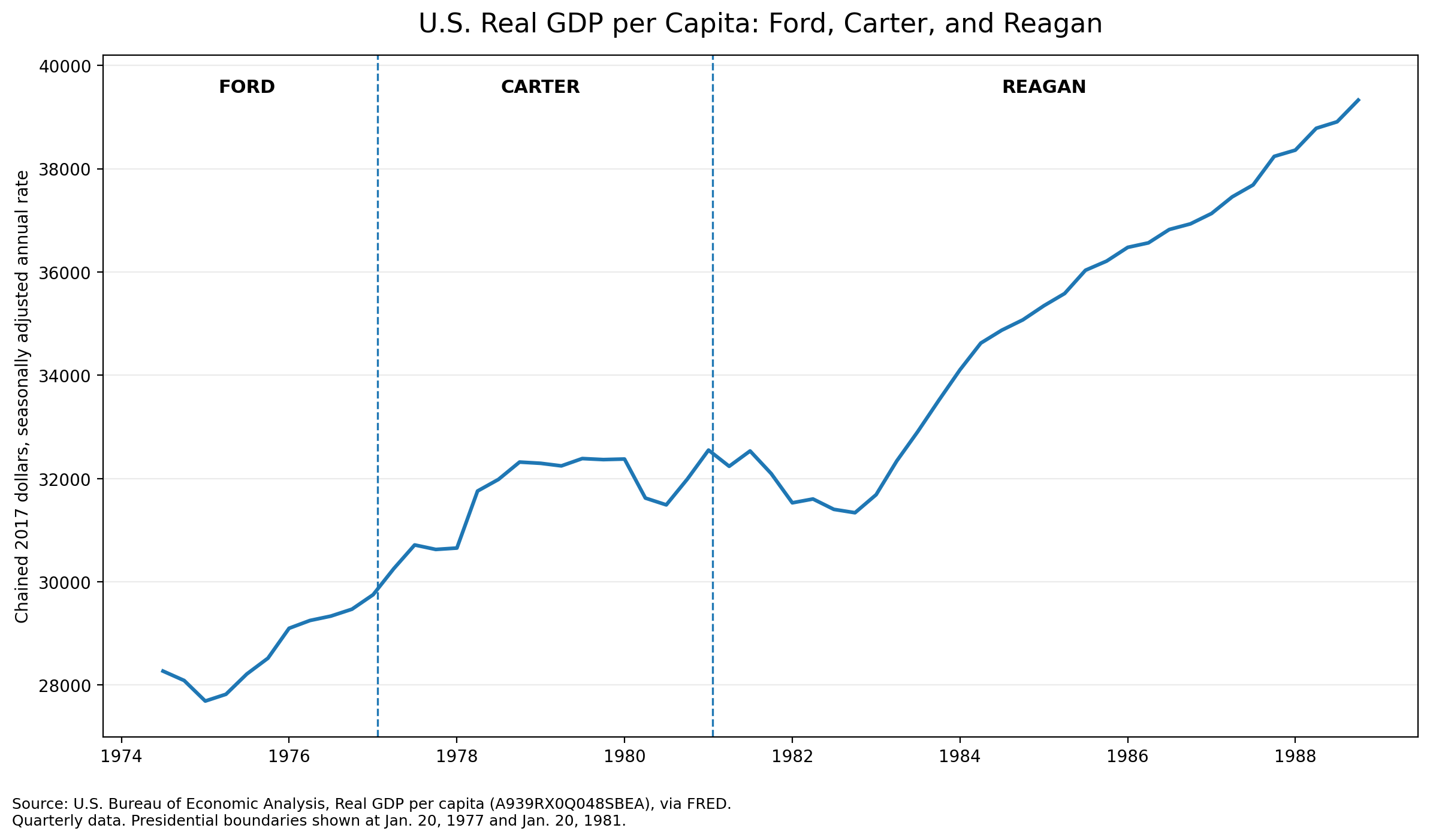
A recent ZeroHedge article makes a provocative claim about the economic revolution normally associated with Ronald Reagan: much of the deregulation for which Reagan received credit had actually been enacted under Jimmy Carter. That claim contains an important truth, but saying that Carter “started” deregulation gives him too much credit for a good economy.
The real story begins earlier, by the mid-1970s, a bipartisan coalition of economists, liberal reformers and market-oriented policymakers had already begun attacking the old system of federal economic regulation. Senator Ted Kennedy and his staff counsel Stephen Breyer played a role in exposing the failures of airline regulation. The Ford administration had already moved toward deregulation and economists increasingly argued that agencies created to control industries had instead become protectors of established firms.
Jimmy Carter inherited that movement, Ronald Reagan then expanded the movement, gave it a much more explicitly free-market ideological identity and ultimately received most of the political credit. Milton Friedman belongs in this history too, but primarily as one of the economists who helped undermine the intellectual assumptions behind the older regulatory and macroeconomic order. He helped make markets, competition and monetary discipline intellectually respectable at exactly the moment stagflation was making the old policy framework look increasingly ineffective.
The actual history, then, is: Kennedy, Breyer, economists and the Ford administration helped launch the modern deregulation movement; Carter turned some of it into law; Friedman helped reshape the broader economic climate; and Reagan expanded and politically branded the revolution.
Deregulation Was Already Underway Before Carter
Airline deregulation is the clearest example. Before Carter entered the White House, critics had begun questioning whether the Civil Aeronautics Board was protecting consumers at all. The CAB controlled airline routes, market entry and fares. In theory this produced stability. In practice, economists increasingly argued that it restricted competition and protected incumbent airlines.
Kennedy held a series of highly influential hearings in 1974 and 1975 examining airline regulation. His chief counsel on the issue was Stephen Breyer, decades before Breyer became a Supreme Court justice. Those hearings helped demonstrate that regulation was often increasing fares and restricting competition rather than protecting passengers. Economists testified that airlines operating outside the CAB’s interstate regulatory system often charged substantially lower fares.
Ford Was Moving in the Same Direction
The Ford administration also moved toward economic deregulation before Carter took office. Gerald Ford advocated reducing unnecessary federal regulation and supported reforms in transportation industries. His administration pushed airline and trucking deregulation and increasingly emphasized competition as an alternative to administrative control. So when Carter entered office in January 1977, the intellectual and political groundwork was already substantially in place.
Then Came Trucking
Trucking followed a similar pattern. The Interstate Commerce Commission tightly controlled routes, rates and market entry. Once again, regulation had originally been justified as a way to stabilize an industry. But over time it increasingly protected incumbent firms from competition. Carter signed the Motor Carrier Act of 1980, substantially reducing federal regulation of trucking.
Railroads Followed
Railroads were another major target. The industry had been subject to federal economic regulation for generations. Carter’s administration sent Congress a railroad deregulation proposal in 1979. The eventual Staggers Rail Act of 1980 dramatically reduced government control over rates and operations. Again, the legislation was the product of a broader political process.
When Reagan entered office in January 1981, he immediately eliminated the remaining controls rather than waiting for Carter’s phaseout schedule to finish. Reagan clearly accelerated deregulation.
Carter was Forced Into Deregulation by Stagflation
Economic pressure mattered enormously. By the late 1970s, the United States was suffering from stagflation: persistent inflation combined with weak growth and high unemployment. The oil shocks made things worse. Traditional economic policy appeared increasingly ineffective. In that environment, deregulation became attractive. If government rules were preventing airlines from lowering fares, restricting trucking competition, distorting railroad pricing and interfering with energy markets, eliminating those restrictions offered a way to reduce costs without another federal spending program.
Carter repeatedly sold deregulation as an anti-inflation policy. So economic crisis certainly increased its urgency. But it is misleading to say Carter was simply forced into it by Congress or his advisers.The movement began before him. He was not the father of deregulation. He was the president who helped it along.
Where Milton Friedman Fits
Milton Friedman helped create the intellectual environment in which all of this became possible. For decades he had challenged the dominant postwar belief that governments could reliably improve economic performance through extensive intervention. He argued that competitive markets generally processed information and allocated resources more effectively than administrative bureaucracies. That argument was becoming increasingly persuasive during the 1970s.
Stagflation Made Friedman Look Prescient
Friedman’s influence became particularly important in macroeconomics. During the postwar period, many economists believed policymakers could exploit a relatively stable relationship between inflation and unemployment. The basic idea was that somewhat higher inflation could produce permanently lower unemployment. Friedman challenged that conclusion, in his famous 1967 presidential address to the American Economic Association, he argued that there was a natural rate of unemployment. Government could temporarily push unemployment below that level through monetary expansion. But workers and businesses would eventually adjust their expectations. The result would not be permanently lower unemployment. It would be accelerating inflation. Then came the 1970s, inflation rose and unemployment remained high. Economic growth weakened and the phenomenon of stagflation seemed to validate an important part of Friedman’s critique. The old simplified Phillips curve no longer looked like a reliable policy guide.That significantly increased Friedman’s intellectual influence.
Friedman Helped Shift the Debate Toward Markets
Friedman’s importance also extended beyond academic economics. He was exceptionally good at communicating complicated economic ideas to the public. His newspaper columns, lectures, television appearances and later the Free to Choose television series brought free-market arguments to millions of Americans. He argued consistently that competition usually worked better than centralized administrative control. That helped create a political environment in which arguments for deregulation no longer sounded radical. By the late 1970s, criticizing regulation had become intellectually respectable across much of the political spectrum.
Monetary Policy Is Where Friedman Had His Strongest Influence
Friedman’s most important connection to the economic transformation of the period was probably monetary policy. He argued that sustained inflation was fundamentally connected to excessive monetary growth. He also rejected the idea that policymakers could permanently reduce unemployment by tolerating more inflation. By the late 1970s, those arguments carried much more weight than they had a decade earlier. And once again, the critical policy shift began under Carter. Carter appointed Paul Volcker chairman of the Federal Reserve in 1979. Volcker then dramatically changed Federal Reserve operating procedures. The Fed placed greater emphasis on controlling bank reserves and monetary aggregates rather than directly stabilizing short-term interest rates.
Friedman and the Great Depression
ZeroHedge also criticizes Friedman’s interpretation of the Great Depression. This deserves some clarification. Friedman and economist Anna Schwartz argued that the Federal Reserve allowed the money supply and banking system to collapse between 1929 and 1933. In their interpretation, that monetary contraction transformed a recession into the Great Depression. That argument became extremely influential, but in fact, Friedman was deeply skeptical of discretionary central banking. He wanted predictable monetary policy precisely because he believed central bankers frequently made enormous mistakes. His criticism of the Federal Reserve during the Depression was that the institution failed to prevent catastrophic monetary contraction. That’s a different argument from advocating permanent monetary stimulus. Later policymakers may have drawn broader lessons from Friedman than he would have endorsed.
Then Reagan Arrived
When Reagan became president in 1981, he accelerated oil decontrol immediately. He issued Executive Order 12291, greatly strengthening White House review of federal regulations and requiring extensive cost-benefit analysis. His administration pursued additional deregulation across communications, finance, energy and other sectors. And perhaps most importantly, Reagan politically embraced the idea of deregulation in a way Carter never fully did. Carter often presented deregulation as pragmatic administrative reform, Reagan presented it as part of a broader philosophical argument: Government itself was frequently the problem.
Reagan Also Backed Volcker Through the Pain
Reagan deserves considerable credit for another reason, Volcker’s anti-inflation campaign caused enormous short-term economic pain. Interest rates soared and the economy entered the severe 1981-82 recession. Unemployment rose above 10 percent. Politicians had every incentive to pressure the Federal Reserve to reverse course. Reagan largely did not and Friedman later praised Reagan for understanding that defeating inflation required enduring a recession rather than forcing Volcker to retreat.
The deregulation revolution was born in the economic and political ferment of the 1970s. Kennedy, Breyer, economists and the Ford administration got the ball rolling. Friedman helped reshape the intellectual climate. Volcker changed monetary policy. Reagan expanded the movement and gave it the political identity by which we remember it today.