“8.1% Guaranteed for Life” Misleading Annuity Video for American Viewers
A YouTube video recently caught my attention with a remarkable title: “It’s boring, but it pays 8.1% guaranteed for life.” If you’re a retiree looking for safe income, that’s one hell of a number. An 8.1% guaranteed return would make most bonds, CDs, Treasury securities, and many retirement-income strategies look almost silly by comparison. Except it’s misleading. There is no 8.1% investment return.
For the enormous number of Americans who encounter the video through YouTube’s recommendation system, there’s another problem: the product, tax system, pension rules, regulatory protection and annuity market being discussed are British. The presenter, James Shack, is a UK-based Chartered Wealth Manager, and the example in the video is explicitly constructed around UK pensions, pounds sterling, UK state pensions and the UK’s Financial Services Compensation Scheme.
None of that makes the underlying analysis fraudulent. In fact, much of the video’s actual retirement-planning discussion is sensible. The problem is the packaging and claims. The phrase “pays 8.1% guaranteed for life” travels very differently across an international platform than the much more accurate statement: “A healthy 65-year-old in Britain can currently exchange £100,000 of capital for roughly £8,100 of annual level income for life.”
First, the British 8.1% number is real
Let’s give the video credit where it’s due, the stated rate isn’t invented. Which? reported on September 28, 2026 that a healthy UK 65-year-old could receive as much as £8,155 per year from a £100,000 pension pot using a single-life level annuity. Canada Life was offering about £8,120 and Standard Life about £8,036 under the same general comparison.
So: £8,155 ÷ £100,000 = 8.155% That’s a legitimate annual payout rate, but it’s not an 8.155% yield. You surrender £100,000. The insurer keeps it and in exchange, the insurer promises to keep sending you income as long as the contract requires. If I invest £100,000 in a security yielding 8.1%, I normally expect something approximating this: £100,000 principal + £8,100 annual income. With the annuity, the structure is closer to: £100,000 surrendered + £8,155 annual lifetime payment
Part of your annual check is investment income, part is effectively your own capital coming back, and part comes from mortality credits, the economic benefit created because members of the annuity pool who die relatively young subsidize those who live much longer. Calling all of that simply “8.1%” invites the viewer to mentally compare it with an 8.1% bond or savings account.
Where the U.S. comparison gets interesting
The American annuity market contains several fundamentally different products that are all casually called “annuities,” and their quoted percentages mean different things. As of October 2, 2026, current U.S. market data look roughly like this:
| Product | What the percentage means | Current U.S. examples |
|---|---|---|
| 5-year MYGA | Actual guaranteed accumulation/crediting rate | roughly 5.75%–6.35% among many A-/A/A+ carriers |
| 7-year MYGA | Guaranteed accumulation rate | up to about 6.55% among A- or better carriers |
| Immediate lifetime annuity, male age 65 | Annual income divided by premium | roughly 7.8%–8.3% |
| Immediate lifetime annuity, female age 65 | Annual income divided by premium | roughly 7.5%–7.9% |
| Joint lifetime annuity | Annual payout divided by premium | usually lower because two lives are insured |
Current CANNEX-sourced U.S. data show five-year fixed annuities around 5.8% median, with some A- insurers around 6.35% and A+ carriers around 5.75%–6.0%. Annuity Rates HQ Blueprint Income recently showed a 65-year-old U.S. male receiving about $7,809 per year per $100,000 from an immediate life-only annuity, or approximately a 7.81% payout rate. A female of the same age was around $7,494. Blueprint Income Another U.S. market survey tracking eight A-rated-or-better insurers put a 65-year-old male at approximately $693 a month per $100,000, or about 8.3% annually, using a five-year-period-certain structure. The source itself cautions that the figure is an index assembled from carrier quotes and repricing rather than a direct quote available identically to every buyer. LifeAnnuities.us
That leads to: An American can, under the right circumstances, see a lifetime-annuity payout percentage similar to the British 8.1% headline. But that doesn’t rescue the headline, it demonstrates why the headline is problematic. The same percentage can mean two entirely different things
Suppose an American finds a five-year fixed annuity paying 6%. That 6% is an accumulation rate. Put in $100,000 and, subject to the contract rules, the account is earning approximately 6%. Now suppose another annuity advertises an 8% lifetime payout. That doesn’t mean the account is earning 8%. You may no longer have an accessible $100,000 account at all. You’ve bought an income stream. The similarity in terminology hides a completely different economic transaction.
Run the 8.1% number through actual return mathematics
Suppose you give an insurer $100,000 and receive $8,100 every year. At first glance: $8,100 ÷ $100,000 = 8.1%. But calculate the investment return based on when you die and the picture changes dramatically. If you die after five years, you’ve received only about $40,500. After ten years, you’ve received $81,000. It takes more than twelve years just to receive $100,000 in nominal payments. And even that ignores the time value of money. Your true internal rate of return depends heavily on longevity, a person who dies relatively early can have a terrible financial return. Someone who lives into his 90s can have a very attractive return. Someone who lives to 105 can do exceptionally well. That’s exactly what an annuity is supposed to accomplish. It’s longevity insurance. That’s the real product. The insurer isn’t giving everyone an 8.1% investment return. It is pooling mortality risk and transferring money across lifespans.
The British guarantee is also not the American guarantee
Here’s another part of the video that should make American viewers particularly cautious. The UK has an extraordinarily strong protection regime for qualifying annuities. The Financial Services Compensation Scheme says that qualifying pensions provided by UK-regulated insurers that constitute long-term insurance contracts, including many annuities, can receive 100% protection with no upper cap if the provider fails. FSCS Americans don’t have the same system. U.S. annuities are backed primarily by the claims-paying ability of the insurance company issuing them. They are not FDIC-insured bank accounts.
If an American insurer becomes insolvent, state insurance guaranty associations provide an additional layer of protection. But the protection is governed by state law and is capped. NOLHGA says that in most states the typical protection is around $250,000 in present value of annuity benefits, although actual state rules vary. NOLHGA
UK qualifying annuity: Potential FSCS protection of 100% with no upper limit.
Typical U.S. framework: Insurance-company guarantee backed by state guaranty-association protection commonly around $250,000 in present value, subject to state rules.
The tax systems aren’t interchangeable either
The video also operates inside the British pension system. UK pension holders can usually take up to 25% of qualifying pension savings as tax-free lump sums, subject to the applicable lump-sum allowance. MaPS American taxation of annuities works differently and varies considerably depending on whether the money came from an IRA, 401(k), qualified annuity, or after-tax assets. So even if two consumers in London and Phoenix are quoted exactly the same 8.1% payout ratio, they may not end up with the same after-tax economic result.
Inflation is still lurking in the background
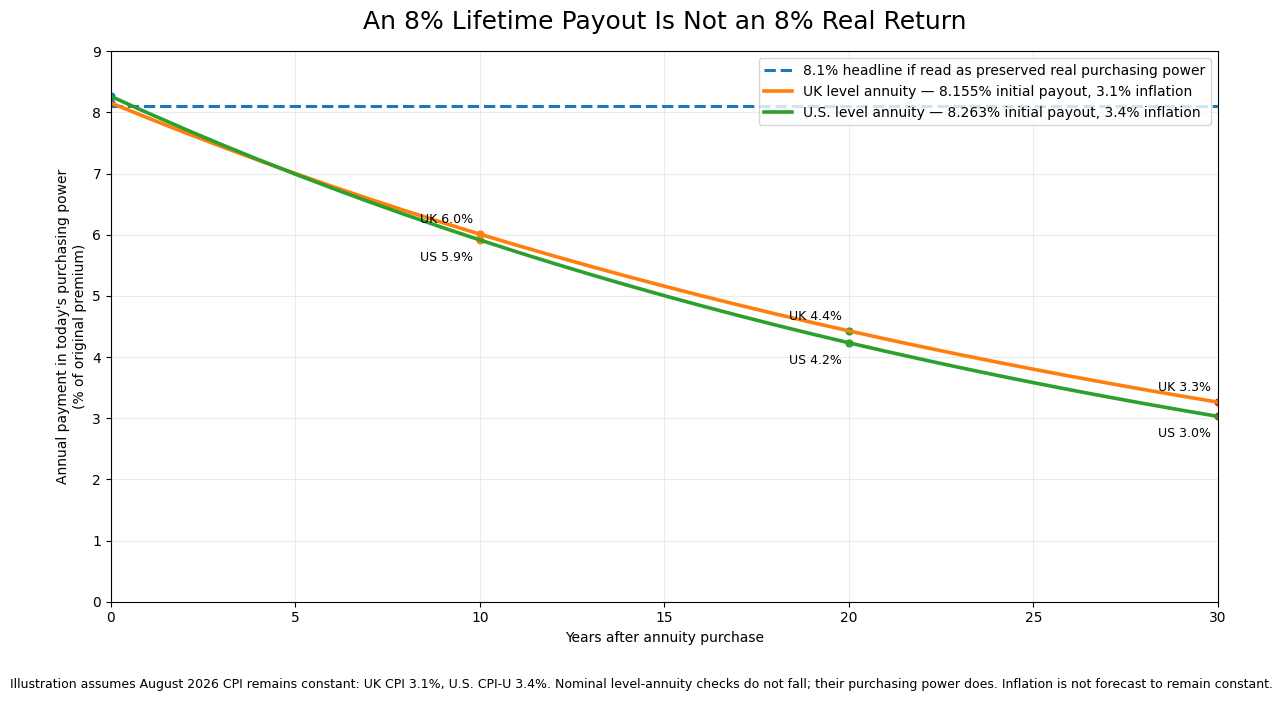
The headline British quote is also for a level annuity. That means the £8,155 payment doesn’t necessarily grow with inflation. Twenty years later the insurer may still send £8,155. The number hasn’t changed, but its purchasing power certainly has. The Which? comparison makes the cost of inflation protection obvious. For a 65-year-old, its top single-life level annuity paid about £8,155, while a joint-life product escalating by 3% annually started at only around £5,678. Which?
What inflation does to the checks
The nominal check stays the same. The following is what that check would be worth in 2026 purchasing power if today’s inflation rate persisted:
| Years into retirement | UK nominal £8,155 | UK real purchasing power | U.S. nominal $8,262.60 | U.S. real purchasing power |
|---|---|---|---|---|
| Today | £8,155 | £8,155 | $8,263 | $8,263 |
| 5 | £8,155 | £7,001 | $8,263 | $6,991 |
| 10 | £8,155 | £6,009 | $8,263 | $5,914 |
| 15 | £8,155 | £5,159 | $8,263 | $5,004 |
| 20 | £8,155 | £4,428 | $8,263 | $4,234 |
| 25 | £8,155 | £3,802 | $8,263 | $3,582 |
| 30 | £8,155 | £3,263 | $8,263 | $3,030 |