The Hidden Costs of ArtCraft: Did One Developer Really Rebuild Adobe Creative Cloud in Two Weeks?
How Claude Code, thousands of AI agent-hours, startup financing, and an existing multimillion-dollar business helped produce one of the most remarkable software development stories of 2026.
Software developer Brandon Thomas has recently attracted considerable attention by releasing a collection of free, open-source applications intended to replace Adobe Creative Cloud. Using Anthropic’s Claude Opus 5.5 and the Rust programming language, he has produced alternatives to Photoshop, Premiere Pro, Lightroom, Illustrator, After Effects, InDesign, and Acrobat Pro.
The applications, available through his GitHub account, appeared at a remarkable pace. Within roughly two weeks, the repositories contained hundreds of thousands of lines of code, extensive testing systems, and applications that closely resemble their commercial counterparts. The story has generated predictable headlines about the end of traditional software development. One developer, armed with Claude Code, can supposedly accomplish what previously required entire engineering organizations.
As someone who has been using ChatGPT, OpenCode, and locally hosted language models to develop substantial Python applications, I found the achievement both impressive and puzzling. We’ve spent weeks dealing with installation failures, regression testing, and integration problems in individual projects. How could someone build an entire Adobe-like software ecosystem in such a short period?
Initially, I assumed the difference was primarily the quality of Claude’s coding model or Thomas’s development methodology. But then I started examining the economics. The story isn’t simply how fast AI can write software. It’s how much AI-assisted development actually costs, who pays for it, and what counts as finished software.
The First Clue: Thousands of AI Development Hours
Thomas’s own GitHub documentation provides an unusually detailed accounting of the work involved. According to the PhotoCraft engineering assessment, between September 30 and October 10, 2026, the project accumulated approximately:
- 1,152 commits.
- 1,004 merged pull requests.
- An estimated 2,000 to 4,000 AI agent-hours.
- Between 10 and 20 concurrently operating coding agents.
Those numbers change the story considerably. This wasn’t one developer sitting at a keyboard and asking Claude to implement Photoshop one feature at a time. It was a coordinated development operation in which numerous AI coding agents worked on separate components simultaneously. There is an important qualification, however. The 2,000 to 4,000 agent-hours are estimates derived from the project’s pull-request history, not measured active inference time. They include activities such as testing, integration, and waiting for reviews. The scale is huge. Traditional software engineering organizations measure development effort in person-hours. ArtCraft effectively compressed thousands of estimated agent-hours into a short calendar period by running many coding processes in parallel.
Who paid for all those Claude tokens?
Claude Isn’t Free, Especially at This Scale
Anthropic’s Claude Opus 5.5 is one of the most capable coding models currently available, but using it through the API incurs charges based on token consumption. As of October 2026, Anthropic’s published Opus 5.5 pricing is:
| API usage | Cost per million tokens |
|---|---|
| New input tokens | $4.00 |
| Generated output tokens | $20.00 |
| Cached input tokens | $0.20 |
AI coding agents repeatedly process large amounts of context, including system instructions, source files, dependency information, and previous interactions. Prompt caching allows repeated material to be reused at a fraction of the cost of processing it as new input. This makes a big difference when running an AI coding operation continuously. For example, suppose an agent consumes the following during one active working hour:
- 1.2 million cached input tokens.
- 150,000 new input tokens.
- 70,000 output tokens.
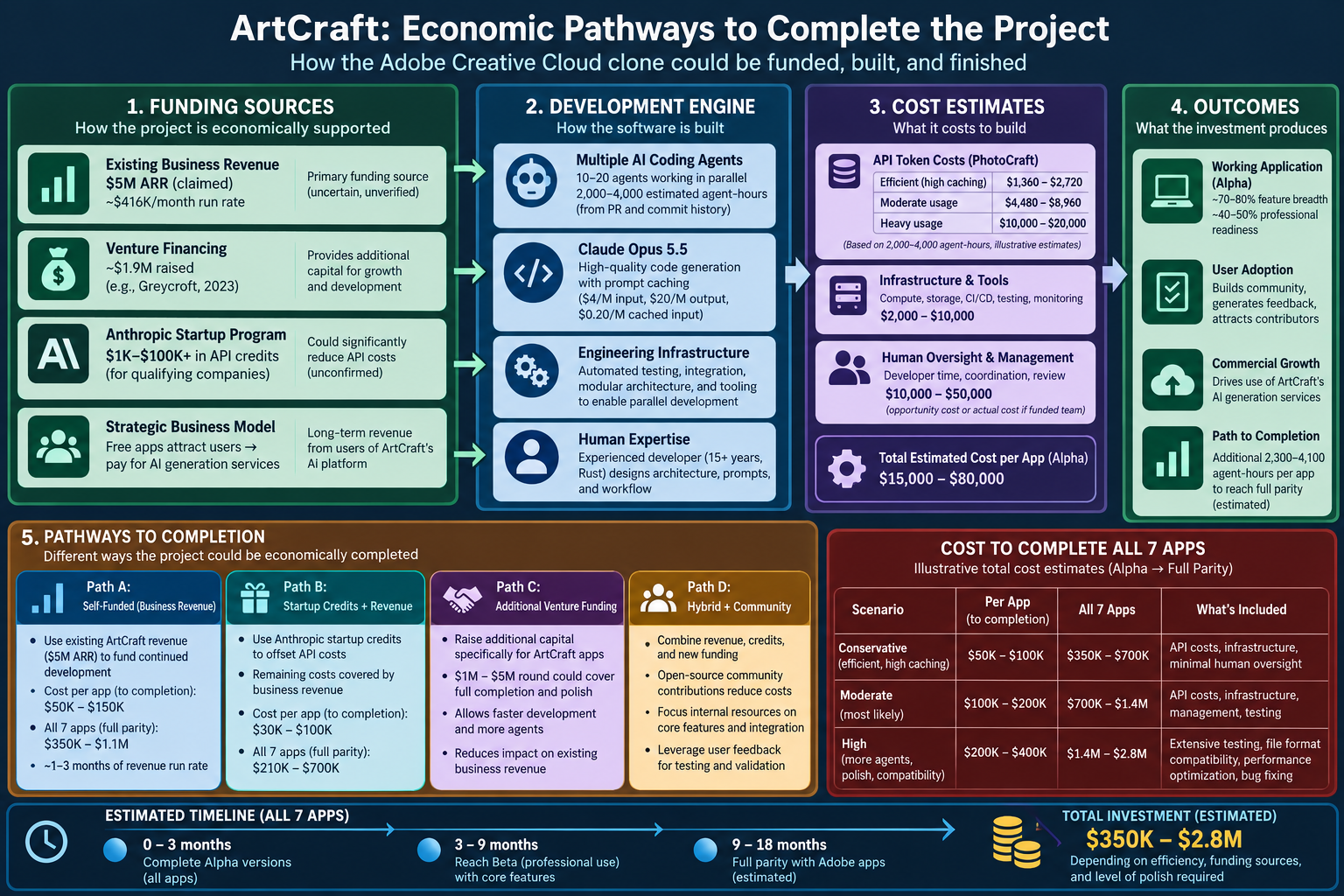
At standard Opus 5.5 prices, that produces an estimated cost of $2.24 per active agent-hour, excluding cache creation, other billable features, and infrastructure costs. If we applied that hypothetical workload to PhotoCraft’s estimated 2,000 to 4,000 agent-hours, the resulting API expense would be approximately $4,480 to $8,960. More aggressive token consumption would increase the amount. More efficient usage, greater caching, or substantial idle time would reduce it. I modeled three illustrative scenarios:
| Usage scenario | Estimated PhotoCraft API cost |
|---|---|
| Efficient, heavily cached | $1,360–$2,720 |
| Moderate consumption | $4,480–$8,960 |
| Heavy consumption | $10,000–$20,000 |
These aren’t ArtCraft’s actual costs. They are hypothetical API-equivalent calculations using stated token-consumption assumptions. We don’t have Thomas’s API invoices, token logs, cache-hit statistics, subscription details, or commercial discounts. Moreover, pull-request-derived agent-hours cannot be assumed to equal hours of continuous token consumption. The estimates apply only to PhotoCraft’s reported workload, not the entire software suite. Still, the calculations suggest that a very large volume of AI development can be economically feasible, especially for an established business. And that brings us to the most revealing discovery.
The $5 Million Detail Missing From the Headlines
On August 22, 2026, well before the Adobe-clone announcement, Thomas discussed his existing ArtCraft business on Hacker News. Responding under the username possibilistic, he said ArtCraft was already being used by film studios and established AI artists. He then made a striking financial claim: “It’s at $5M ARR and growing 65% month-on-month by word of mouth.” The original Hacker News comment is publicly available.
ARR means annual recurring revenue. A business operating at $5 million ARR has a recurring revenue run rate equivalent to approximately $416,667 per month. Importantly, this was Thomas’s own claim, not a figure independently verified through audited financial statements. ARR also isn’t profit. A business providing AI image and video generation may have significant inference, hosting, and operational expenses.
Importantly, this was Thomas’s own claim, not a figure independently verified through audited financial statements. ARR also isn’t profit. A business providing AI image and video generation may have significant inference, hosting, and operational expenses. If the reported revenue is approximately accurate, Thomas isn’t simply a hobbyist somehow financing an enormous Claude operation out of his personal savings. If the reported revenue is approximately accurate, Thomas isn’t simply a hobbyist somehow financing an enormous Claude operation out of his personal savings. He is associated with an existing commercial AI software business that potentially has substantial recurring revenue. There is also evidence of outside investment.
CB Insights lists ArtCraft as having raised approximately $1.9 million, with historical financing involving Greycroft in 2023. That doesn’t establish how much capital remained available in October 2026. It does establish that the business has a financing history beyond one person paying for coding tokens. At $5 million ARR, even a $20,000 expenditure represents only about 4.8% of one month’s annualized gross revenue run rate.
Free Software as a Business Strategy
Another important detail appeared in Ars Technica’s October 7 reporting. Thomas explained that the free creative applications would be supported by selling token-based access to ArtCraft’s existing AI image and video generation platform. The free applications attract attention, users, GitHub contributions, and potentially customers for ArtCraft’s commercial AI services. The ArtCraft Services repository backend includes customer authentication, credit accounting, usage billing, Stripe integration, inference-provider routing, and asynchronous processing. ArtCraft already had commercial infrastructure supporting its AI products.
This creates a potentially powerful economic cycle: Commercial AI revenue funds free development. Free applications attract users. Some users purchase commercial AI services. That revenue funds further development. Whether this strategy ultimately succeeds remains an open question, but it provides a rational economic explanation for financing the effort. It also means ArtCraft should not automatically be compared with an individual programmer operating on a $20 or $100 monthly AI subscription.
Could Anthropic Have Supplied Free Tokens?
There is another plausible financing mechanism: startup credits. On October 6, Anthropic announced an expansion of its Claude Startups program, offering eligible companies benefits that include:
- $1,000 in API credits.
- A free year of Claude Team for qualifying organizations.
- Potentially up to $100,000 in additional API credits through participating venture-capital partners.
A company with investor backing could potentially qualify for significant assistance. Such credits could cover a considerable amount of AI development, depending on the model, caching strategy, and intensity of use. However, I found no public evidence establishing that Thomas or ArtCraft actually received these credits.
The expanded program was also announced after PhotoCraft development had already begun. Earlier startup-credit arrangements existed, but the October expansion alone cannot explain the initial work. It’s entirely possible that ArtCraft received credits, commercial discounts, enterprise allowances, or other assistance. It’s equally possible that it paid for much of the development using existing business revenue. Without actual billing information, we cannot determine which explanation is correct.
Claude Max subscriptions offer another possibility. The $100 and $200 monthly plans provide higher usage allowances for Claude Code, but they are not unlimited. Supporting 10 to 20 continuously busy Opus coding agents would require considerably more capacity than can safely be assumed from one ordinary subscription.
The Second Hidden Cost: Software That Exists Isn’t Necessarily Software That’s Finished
Perhaps the most revealing material is buried in ArtCraft’s own engineering documentation. On October 3, PhotoCraft’s early estimates suggested the application was approximately 82% of the way toward Photoshop parity, with another 25 to 40 hours of parallel development potentially reaching about 95% functional completeness. By October 10, the assessment had changed dramatically.
The revised parity analysis estimated:
| PhotoCraft measure | October 10 assessment |
|---|---|
| Feature breadth | Approximately 76% |
| Readiness for professional work | Approximately 45% |
| Additional agent-hours to beta | 1,100–1,800 |
| Additional agent-hours to full parity | 2,300–4,100 |
| Current maturity | Alpha |
We have seen a similar pattern in our AI development projects. Generating the initial application is often surprisingly fast. Making installation reliable, preserving existing data, fixing asynchronous failures, and validating the application against real-world use can consume far more time than expected. AI makes software creation much faster, but it does not automatically eliminate the cost of software validation.
The Third Hidden Cost: Human Engineering Expertise
The headlines frequently describe Thomas as a solo developer using Claude. Thomas has publicly described himself as an experienced software engineer with approximately 15 years in the industry and substantial experience working with Rust. He also stated that an existing ArtCraft team would support the applications. The repositories reveal much more than simply telling Claude to write code. They contain detailed development instructions, architectural boundaries, testing requirements, command interfaces, and documentation for measuring compatibility against the original applications.
Even the Choice of Coding Tool Changes the Bill
An additional finding comes from an October 2026 research paper, What Does a Harness Buy? Tokens, Mostly, by Yangze Liu and Zhongyi Han. The researchers compared AI coding harnesses, including Claude Code, OpenCode, and mini-SWE-agent. A coding harness is the software surrounding the language model. It manages prompts, repository context, tools, execution, and interaction history. The study found that using the same underlying model on the same tasks could produce differences of up to three times in cost per task, depending on the harness.
Much of the difference came from the amount of repeated context and tool-description overhead. The paper is a preprint, and its benchmark findings should not be treated as universal rankings of coding tools. Nevertheless, the economic implication is clear. Two developers using the same model may pay very different amounts to accomplish similar work.
Prompt caching, context management, tool selection, retry behavior, and the number of interactions required to finish a task all affect the economics. And model quality affects them indirectly. A cheaper model that requires ten unsuccessful repair attempts can easily become more expensive than a stronger model that produces one correct repair. The correct measurement is not tokens generated, lines of code written, or even the number of completed pull requests.
It is total cost per independently verified, working feature.
What ArtCraft Really Demonstrates
After examining the public evidence, I don’t think the ArtCraft story is primarily about one person discovering a magic AI coding prompt. It demonstrates the convergence of several factors:
- A highly capable coding model.
- An experienced software architect.
- A development system designed to support substantial parallel execution.
- Potentially significant commercial resources.
- Aggressive use of automation and testing.
- An early-alpha release strategy that prioritizes rapid feature delivery while accepting that important reliability work remains.
The financial component is particularly important. An AI coding project that appears almost impossibly productive may be consuming thousands of dollars in inference services, benefiting from startup credits, or drawing on the resources of an established business. None of those possibilities invalidates the technical accomplishment. But omitting them produces a misleading comparison for individual developers. Someone running a local model on a consumer GPU, or paying for a modest monthly AI subscription, shouldn’t assume that matching ArtCraft’s apparent throughput is simply a matter of writing better prompts. The resource budgets may be fundamentally different.
What Independent Developers Should Learn
My conclusion isn’t that smaller developers need dozens of AI agents or tens of thousands of dollars in token budgets. In fact, my experience suggests that increasing the number of coding agents before improving the development process can make things worse. A more practical strategy is to use AI economically and measure whether it actually delivers working software.
That means defining a concrete task, requiring a reproducible failure before attempting a repair, testing the real application, and stopping when repeated approaches fail. It also means using stronger models selectively when complex architectural or debugging work justifies the expense. For a difficult bug, spending $10 on a premium model that solves the problem can be cheaper than spending several days supervising a lower-cost model that repeatedly produces incorrect fixes.
The underlying discipline is the same one engineers have always needed: clearly specified objectives, controlled experiments, measurable acceptance criteria, and honest accounting of failures. AI improves the speed at which we can execute that process. It doesn’t make the process unnecessary.
The Real Cost of an AI Software Revolution
ArtCraft is a significant demonstration of how much software development has changed. A capable engineer can now direct AI systems to produce applications at a pace that would have seemed extraordinary just a few years ago. That popular narrative leaves out important details. Thomas has publicly claimed that his existing business was already generating $5 million in annual recurring revenue. Public databases record previous venture financing. His repositories describe thousands of estimated AI agent-hours and substantial parallel development. And his own readiness assessments acknowledge that considerable work remains before the applications can reliably replace professional Adobe software.
We still don’t know the actual token bill, whether startup credits reduced it, or precisely how much human labor supported the effort. The real ArtCraft story isn’t that software can now be built for free. It’s that AI has dramatically reduced the cost of generating software, while shifting more of the engineering burden toward architecture, verification, integration, and the economics of computation.
This analysis is based on publicly available information as of October 13, 2026. Revenue figures are attributed to the developer’s public statements, engineering progress figures come from project-maintained documents, and token-cost calculations are illustrative estimates rather than verified ArtCraft expenditures.
Primary sources: ArtCraft GitHub | PhotoCraft Engineering Assessment | Brandon Thomas on Hacker News | Ars Technica | Anthropic Opus 5.5 Pricing | Anthropic Startup Program | TechRadar Hands-On Review